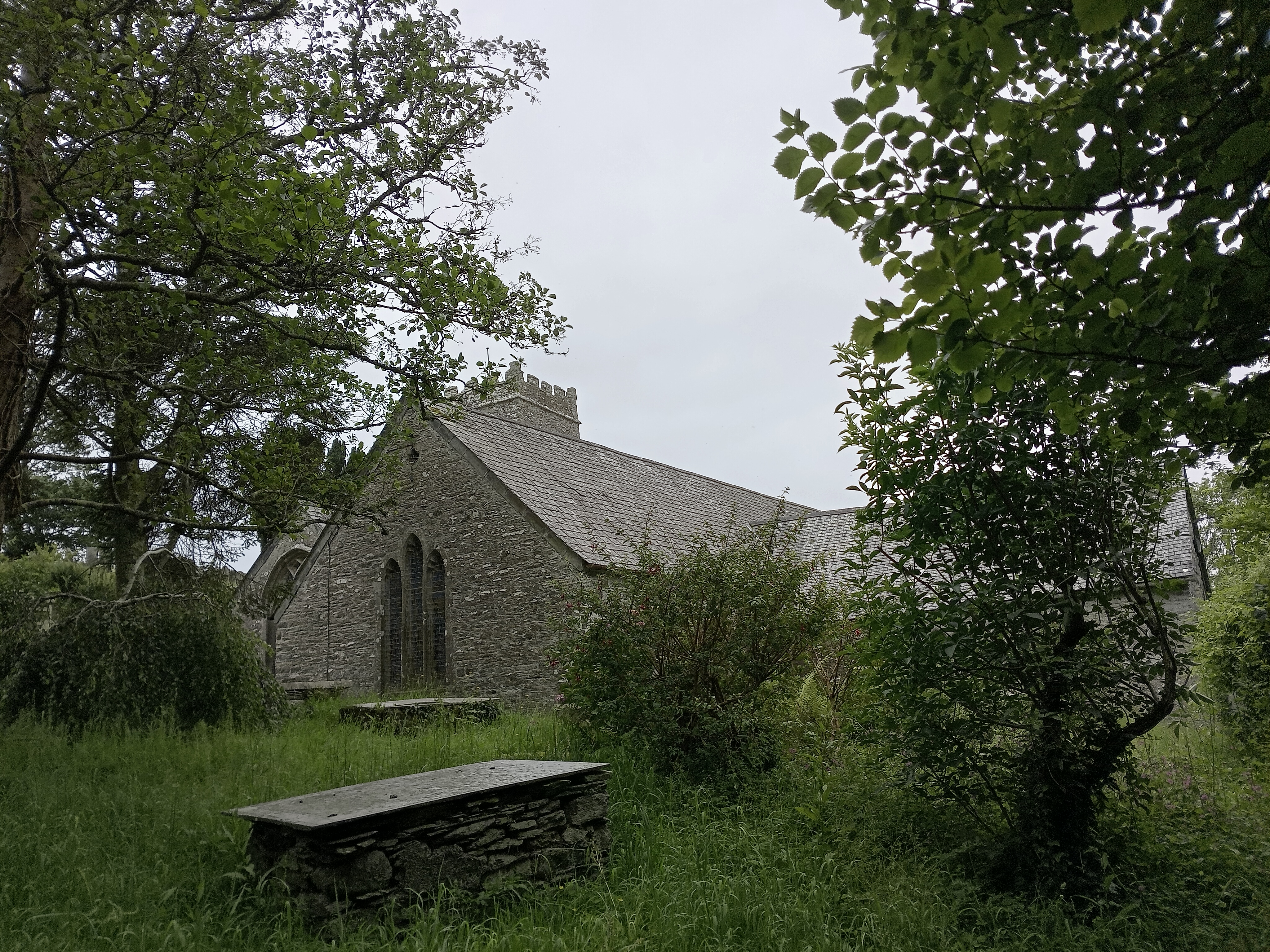
The text of a sermon preached on the First Sunday after Trinity, June 7th, 2026, at the Church of St Tallanus, Talland, Cornwall.
The readings were, Genesis 121-9 Romans 413-end Matthew 99-13, 18-26
Many of Jesus’ parables begin with words such as, the kingdom of heaven is like …, or, with what shall I compare the kingdom of God?
But Jesus doesn’t just tell us what the kingdom of heaven is like – he shows us.
By the way he lives, by the things he does, by the things he says, by the way he treats other people, Jesus consistently shows us what the kingdom is like.
But he does this not simply to show us or tell us what it’s like – but to model the way in which we too can make it real – in our own lives and in the communities in which we live as we emulate his actions and attitudes in our own society..
This morning’s Gospel reading is one such example – or perhaps even two or three!
He doesn’t mention the kingdom of God here at all – he lives it out; he makes it real; he invites people into the kingdom by transforming their lives.
But not only that but shows us that the kingdom is for all, regardless of their background.
The kingdom is not about who we are, but who we can become.
In this morning’s short except from Matthew’s gospel there are no parables and only one brief piece of teaching from Jesus – but it is packed with things for us to learn about God’s kingdom.
It begins as Jesus, walking past the tax office, spots Matthew and invites the tax collector to Follow me. Matthew immediately rises and follows Jesus.
Does Jesus already know Matthew? Have they talked before? Has Matthew seemed like a possible disciple? We don’t know. But the short story that follows tells a lot about the kingdom – and who is called to be a part of it.
Jesus, at table with tax collectors and sinners, is criticised by the Pharisees, Why does you master eat with tax collectors and sinners?
Jesus’ reply is very telling. Not only does it put his critics in their place, but it also provides us with plenty to think about. He could have introduced what he said to the Pharisees with the words, In the kingdom of God …, because that is what he describes,
It is not the healthy who need the doctor, but the sick. Go and learn the meaning of the words: Mercy is what pleases me, not sacrifice. And indeed I came to call not the upright, but sinners.
Clearly, the Pharisees need to learn that lesson, but so do we who aspire to be citizens of the kingdom of God. These are words which remind us of the need to understand that no one, in particular sinners, are beyond the love and mercy of God. Indeed the sinners are the people who have the most need of God and his mercy.
Jesus is so clear, it is not the healthy, but the sick; mercy, not sacrifice; I came to call not the upright, but sinners.
These words are surely as much for his disciples as they are for the Pharisees, and therefore, for us.
The next part of our reading this morning features two acts of healing. The one of the official’s daughter, the other of the woman with the haemorrhage.
They come form very different backgrounds. The official’s daughter has status in her community. Her father holds an important office; her life is, no doubt, comfortable and her death is mourned by the crowd and the musicians gathered at the official’s home.
By contrast the woman has suffered for many years. She has, because of her condition, been an outcast in society. She is almost certainly poor and has probably been reliant on the generosity of others. She has not been able to attend synagogue worship for twelve years because her haemorrhage renders her unclean. She is even taking a risk just being part of the crowd around Jesus; and risks everything by daring to touch Jesus. According to the Law he should avoid her and she him.
Jesus asks no questions, does not try, in any way, to establish whether these people are worthy of his healing, life-giving authority.
The official comes up to him, saying,
My daughter has just died, but come and lay your hand on her and her life will be saved.
There is no hesitation. Jesus doesn’t check with the locals that the official is worthy, or that the daughter is deserving. Immediately Jesus rose, and with his disciples, followed him.
When the woman comes up behind him and touches his cloak, he turns to her. There is no, What do you think you are doing? At once, Jesus recognising her need says to her,
Courage, my daughter, your faith has saved you.
At the official’s home Jesus enters at once, after rebuking the crowd and sending them away, goes inside and takes the girl’s hand and she revives and stands up.
Jesus is unconcerned about status, wealth, rank or worthiness; only by need.
The tax collector, the official’s daughter, the woman with the haemorrhage. He asks no questions, does no checking, does not criticise or rebuke, requires no profession of faith; he simply responds to their need.
I started by saying that Jesus models for us what the kingdom of God is like. And here that is what he has done.
In his dealings with these three individuals he has shown, by the way he responds to them, and their needs, what the kingdom of God is like.
It is inclusive, nobody is rejected or turned away.
It offers forgiveness, mercy and acceptance, not judgement, criticism or shunning.
It offers healing and renewal.
It is life-giving and affirming.
Time and again throughout the gospels these are the attitudes that Jesus models for us.
As individual Christians, as a Church, at our best we share those attitudes.
But too often we can be judgemental, exclusive, uncaring, indifferent.
Jesus is consistent in the way he reveals the kingdom. He reveals it to be inclusive, merciful, healing and life-giving.
That is an example for us. But it is also a challenge. And a challenge we dare not ignore, because for us to act otherwise is to reject the values of God’s kingdom.


Leave a Reply