Welcome to exultemus. Through this blog I hope to give air to my thoughts about the world as seen through the eyes of faith.
I have been a priest in the Church of England for more than forty years and am now retired and living in South East Cornwall. I worship at St Neot, and am happy to help out in local churches when asked.
You are welcome to leave comments agreeing or disagreeing, but I reserve the right to remove any offensive or unnecessarily personal remarks. I may respond – if your comments seem likely to start an interesting debate.
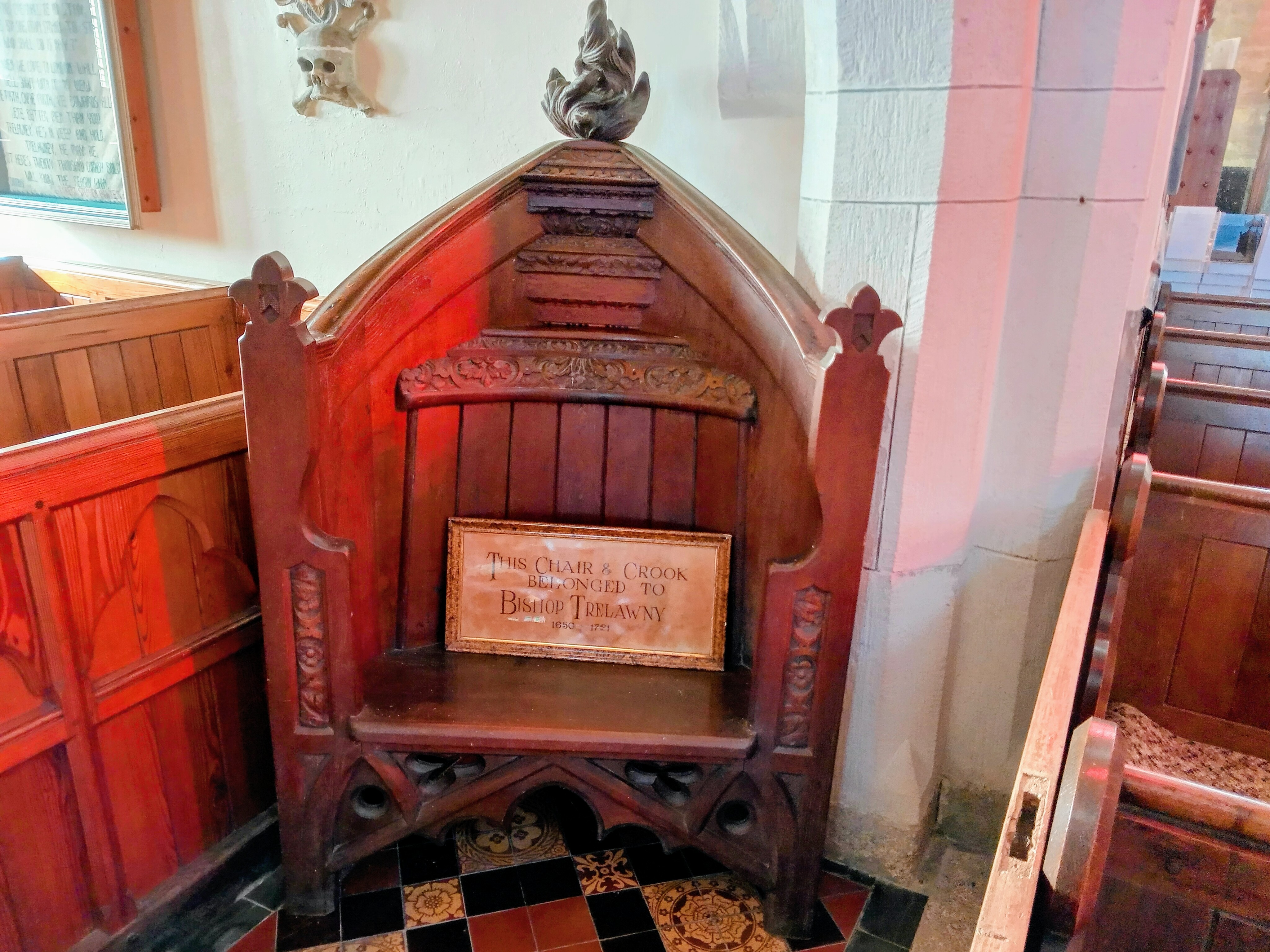
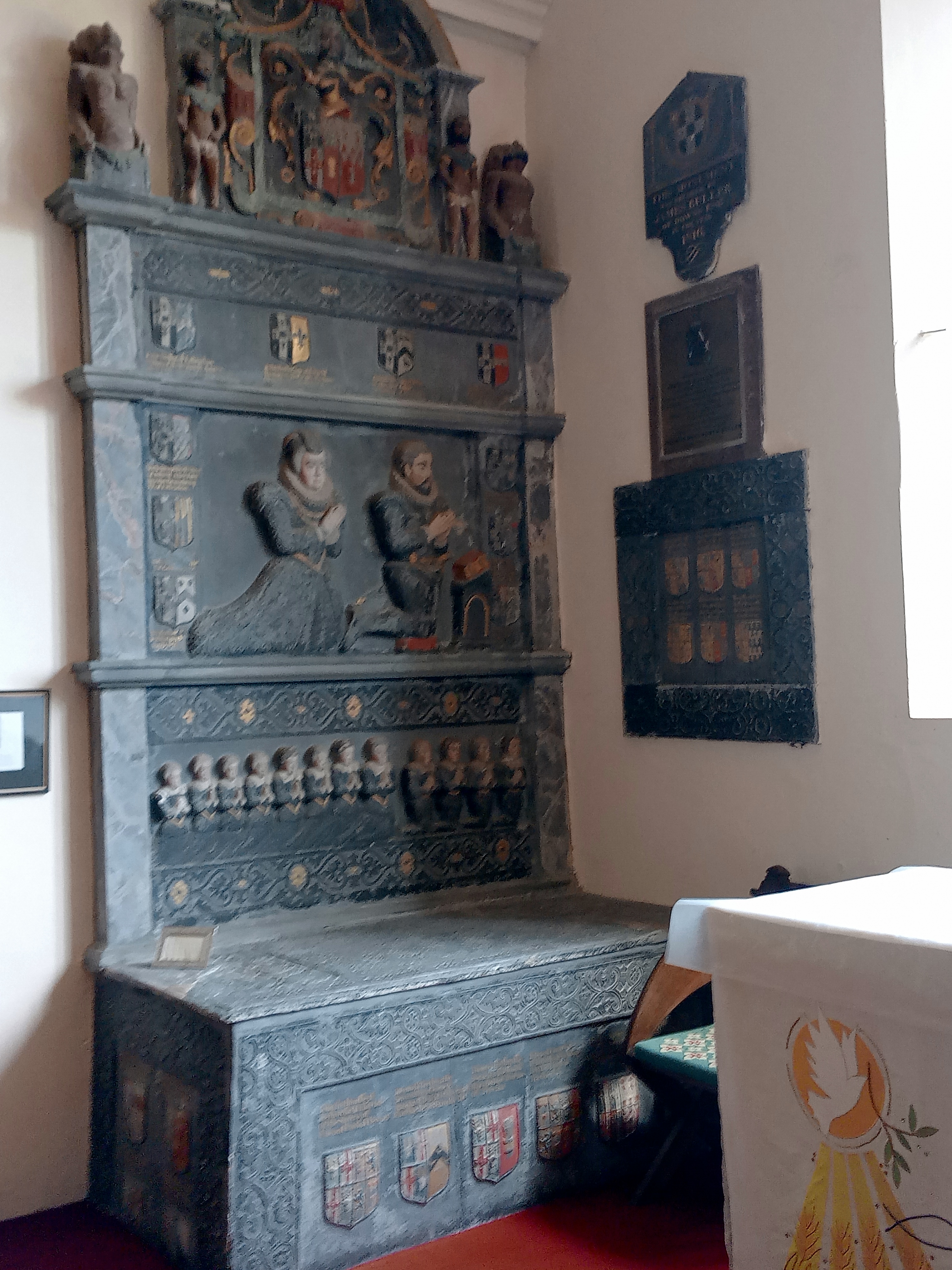
Bishop Trelawny’s Chair in St Nun’s Church, Pelynt
The text of a sermon preached at St Nun’s Church, Pelynt, Cornwall on the Last Sunday after Trinity, 25th October.
The readings set were, Deuteronomy 341-12 1Thessalonians 21-8 Matthew 2234-end
Master, which is the greatest commandment in the Law?
The Pharisees, says Matthew, are putting Jesus to the test by asking this question. They’ve noticed already that Jesus and his disciples are not as scrupulous about the little details of the Law as they might be. For them keeping the Law is all about observing every letter of the Law. Even the seemingly tiny things are important. Remembering to wash before eating (a point the Pharisees made), or keeping separate pots for milk and meat, are as important as not killing. They are all equally ways of failing to keep the Law. So here they are testing Jesus’ orthodoxy.
The question is a simple one with an answer that everyone should know,
You shall love the Lord your God with all your heart, with all your soul, and with all your mind. This is the greatest and the first commandment. The second is like it: You shall love your neighbour as yourself. On these two commandments hang the whole Law, and the Prophets.
Jesus gives the right answer – the answer that the Pharisees would expect from an orthodox teacher. This has been the answer to this same question for decades, perhaps even centuries in Jewish teaching. They know it, we know it and Jesus knows it.
In Luke’s gospel this answer is followed by the question, And who is my neighbour? To which Jesus responds with the parable of the Good Samaritan. But here it is Jesus who asks a follow up question.
We’ll come to that question in a moment. But first we need to think about what it means to love our neighbour. Because the problem with what the Law requires is not about knowing it, but doing it.
You know, I know, the Pharisees knew that they should love their neighbour, but that doesn’t make it an easy thing to do. It sounds simple but experience has taught us that it’s not that straightforward.
Thomas Aquinas, the great thirteenth century teacher, defined love like this,
to will the good of the other (velle bonum alicui)
It is not about feeling warmly towards someone, it’s not about tolerating them, or wishing them well, but about actively, materially orienting our will towards the flourishing of another person.
There is nothing sentimental about love. It is not something that comes and goes. It is a choice that we make, again and again, in the direction of someone else’s good.
But that is not possible if we are full of concern for our own well-being and primarily focussed on ourselves. We cannot love someone that we feel is beneath us. We need to make room in our heart for someone else’s well-being to matter as much as our own.
And making that room requires humility. Humility is making as much room in our heart for another as for ourselves.
And it is this that makes the keeping of the commandment so difficult for us. We try to go directly to loving our neighbour without first making room in our heart for them.
Humility and love go hand in hand. They belong together and are inseparable. There can be no true love without humility. Humility is about valuing others. And valuing others is a prerequisite for love.
So, now we come to question that Jesus asks the Pharisees to answer – though they are unable to do so,
What is your opinion about the Messiah? Whose son is he?
Well, that’s an easy question, David’s they answer. But the follow up is impossible for them to answer,
Then how is it that David, moved by the Spirit, calls him Lord, where he says: The Lord said to my Lord, take your seat at my right hand, till I have put your enemies under your feet? ‘If David calls him Lord, how then can he be his son?’
In these words from Psalm 110 David has acknowledged that a descendant of his, over whom, according to tradition, he could claim superiority as his Lord. He has made room in his heart for a descendant of his to be seen by him as his superior, his Lord.
The Pharisees still do not understand – and Jesus does not explain himself. They’ll need to reflect on it and work it out for themselves.
David has oriented his will to make room for the good of his descendant – his status as his Lord – to be a priority for him. It’s like John the Baptist saying,
the one who comes after me is more powerful than I, and I am not fit to carry his sandals (Mt 311).
John and David have done that essential work of humility; the Pharisees have not. And the good Samaritan clearly has room in his heart for the well-being of his neighbour.
And we see the same attitude in Jesus himself. Particularly when he washes his disciples’ feet at the last supper. He has made room in his heart to show his love for them by treating them as his superior. It is why Peter is so horrified at the prospect of Jesus washing his feet.
So the question for us today is, have I made room in my heart to think of others as people whose well-being matters as much as my own?
And the question matters because answering it is the prerequisite for being able to love our neighbour as ourselves, and the key is having an attitude of humility in our relationships with other people. And that is something we will always need to work on. We can ever be complacent about it, or take such an attitude for granted.
Because it is really not good enough to have a good intention to love our neighbour. We actually have to do it – because Jesus told us that it is the greatest of all the commandments.
The text of a sermon preached at St Bartholomew’s Church, Warleggan and St Neot, Cornwall for the Feast of St Luke, 18th October 2026.
The set readings were, Isaiah 353-6 2 Timothy 45-17 Luke 101-9
Today we celebrate the life and witness of St Luke – the author of the gospel that bears his name and of the Acts of the Apostles. St Luke is the patron saint of doctors, artists, bachelors, surgeons and butchers. Having said all that there is little that we know about his life.
Luke, we know, was a companion of St Paul – Paul writes in Colossians (414) of Luke, the beloved physician, and also mentions his presence with him in 2 Timothy (411) and in the letter to Philemon (25). In the book of Acts, there are five sections which, because of the use of the pronoun we, suggest that the author of Acts was present with Paul towards the end of his travels and on his journey to Rome.
That’s about the totality of our knowledge but there are, of course, legends about Luke. He is said to have been an artist, and painted many icons of Jesus and Mary. He is said to have been the first to paint the Madonna and child. Some accounts say that he was martyred by hanging from an olive tree, others that he lived a long life dying in Boetia, in what is now central Greece, at the age of 84.
There is little if any of this about which we can be sure. Even that the author of the gospel and Acts is the same Luke of whom Paul speaks is less than certain – but it hardly matters.
We have in his writings plenty to tell us who Luke really was – and it is in his gospel and in the Acts of the Apostles that we shall find the real Luke.
Luke’s gospel is one of the Synoptic Gospels, together with Matthew and Mark, which share a general shape and a great deal of common material.
But Luke is quite different in many ways from the others. He is widely believed to have been a Gentile convert to Christianity, and the quality of his Greek in his writings (the most refined in the New Testament) reveal an educated man. If he was a gentile he is the only non-Jewish author in the New Testament.
His gospel opens with a detailed account – not of Jesus’ birth – but of John the Baptist’s. And woven within that birth narrative is the account of the annunciation to Mary and her visit to her cousin Elizabeth.
This highlights immediately one of the features of Luke’s gospel. He often uses the experiences of women to tell his story. Mary receives the call to motherhood through the angel; Elizabeth affirms Mary as blessed to be the mother of my Lord. Mary is given a song of praise in the Magnificat (more of this in a moment); and Elizabeth is the one who insists that John is to be called John (rather than Zechariah) – although they do have to check with Zechariah that that is OK.
In Matthew, the only other account of Jesus’ birth, the whole story is told almost exclusively from Joseph’s perspective.
Other stories giving women a key role are sprinkled through the gospel. Anna, the prophetess welcomes Jesus in the Temple; the healings of Peter’s mother-in-law, the woman with the haemorrhage, Jairus’s daughter; the son of the widow of Nain is raised to life; the woman sinner who anoints Jesus’ feet; the list of the the women who followed Jesus; the widow’s mite. And, it is the women who, watching Jesus die on the cross, then prepare spices to anoint his body and return to the tomb on the day of the resurrection and finding the stone rolled away, hear the good news from the angels.
I said we’d return to the Magnificat. This song is, to use a phrase from the sixties, a protest song. Mary sings of the. justice we can expect from God. He is a God who looks on the lowliness of his servant, he is a God who scatters the proud in the thoughts of their hearts. He is a God who brings down princes from theirthrones and raises up the lowly. He is a God who fills the hungry with good things and sends the rich away empty.
The Magnificat reveals a God who favours the poor, the hungry, the needy and the powerless over the rich and powerful. And in turn we realise that this is the God that Luke believes in and wants his readers to believe in too.
There are other examples. Where Matthew’s beatitudes (5) speak of the poor in spirit and those who hunger and thirst for righteousness Luke, in his beatitudes (620-23) speaks of the poor being blessed and the hungry being fed.
In the story of the widow’s mite (Luke 211-4) we learn that the offering of the poor, small though it be, is more pleasing to God than the large gifts of the wealthy.
Forgiveness and generosity are themes in Luke’s gospel too. Think of the parable of the Prodigal son and the Good Samaritan – parables that only Luke records. Think too of the thieves crucified with Jesus and how forgiveness is made available even in that extreme moment to the penitent thief.
The Acts of the Apostles is very different. This is not now the story of Jesus – at least not directly. It is rather the story of the earliest days of the Church and the work of the Holy Spirit in directing and empowering it.
That story is told principally through two characters – Peter and Paul. And, like, the gospel it tells of a God who overturns human expectations. Peter, and in turn James and the other apostles, are forced by God, through Peter’s dream and conversion of Cornelius and his household (Acts 10) to understand that the gospel is Good News not just for the Jews but for the Gentiles too.
And then again by the miraculous conversion of Saul. We see how God can use a persecutor of the Church to spread his gospel. And so we see, within a short time the gospel being spread throughout the Eastern Mediterranean and as far as Rome.
We may know few facts about Luke’s life but his writings reveals a great deal about him – and his faith. But they reveal a great deal about God and Jesus Christ too. Without Luke’s special and unique message we would be the poorer in our understanding of how God has brought salvation and hope to the world through Jesus Christ.
I end with a short poem – a sonnet – called Luke by the priest-poet Malcolm Guite. You were given a copy of it on the way in.
Luke
His gospel is itself a living creature A ground and glory round the throne of God, Where earth and heaven breathe through human nature And One upon the throne sees it is good. Luke is the living pillar of our healing, A lowly ox, the servant of the four, We turn his page to find his face revealing The wonder, and the welcome of the poor. He breathes good news to all who bear a burden Good news to all who turn and try again, The meek rejoice and prodigals find pardon, A lost thief reaches paradise through pain, The voiceless find their voice in every word And, with Our Lady, magnify Our Lord.
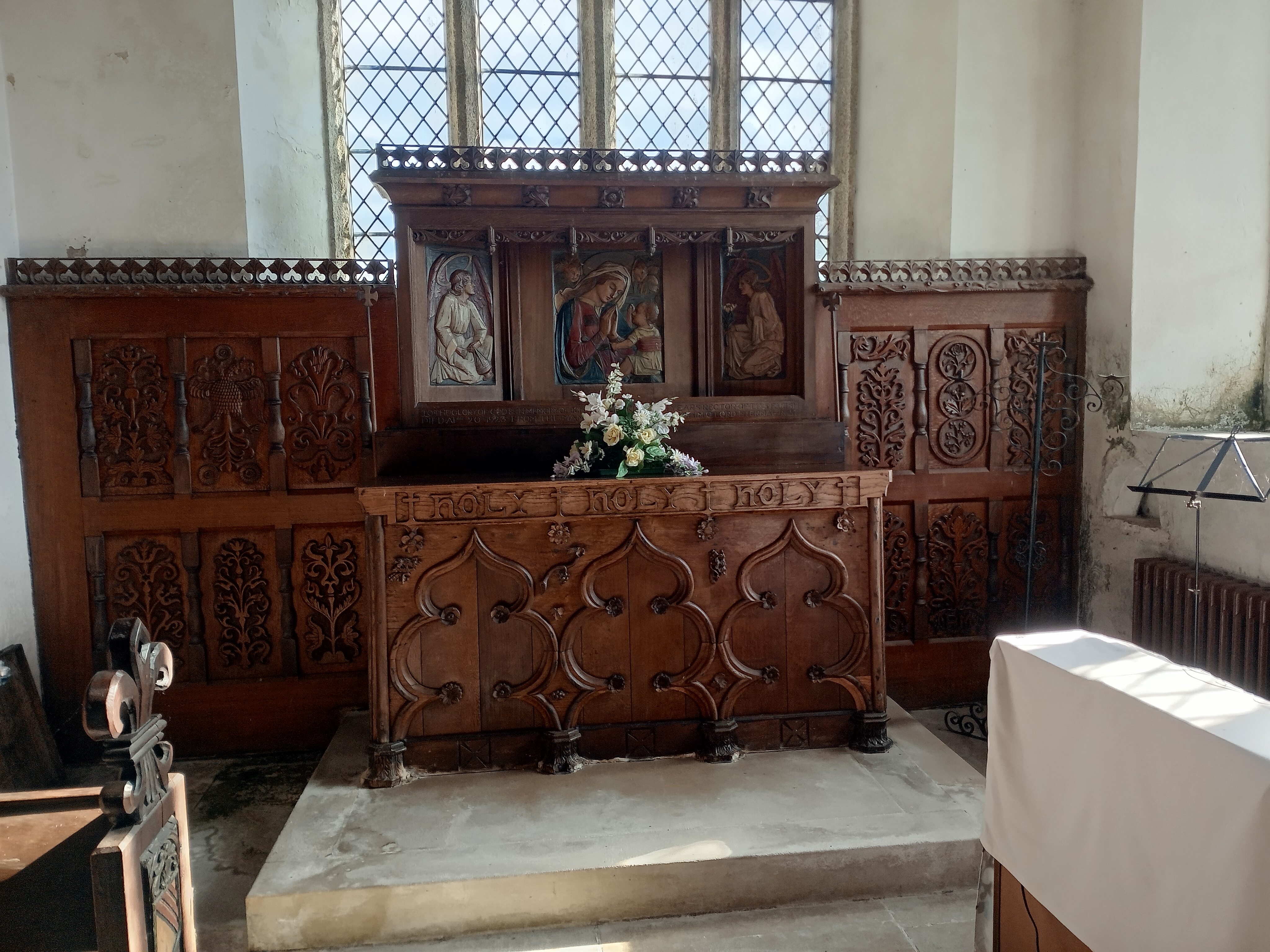
The Lady Chapel, at St Marnarch’s Church, Lanreath
The text of a sermon preached at St Marnarch’s Church, Lanreath and at St Ildierna’s Church, Lansallos, Cornwall on Sunday 4th October 2026.
The set readings were, Exodus 201-4, 7-9, 12-20 Philippians 34b-14 Matthew 2133-46
Jesus is now in Jerusalem. His purpose in coming to Jerusalem is to fulfil his destiny. He knows, as we do, that he must die and that he will rise again. The character of the events in his story in Matthew’s gospel are now quite different from the way they were prior to his arrival in the city.
In his Galilean ministry he had been an itinerant teacher, healer and miracle worker. There were many such individuals in the Jewish society of this time. Jesus, of course, has got himself noticed because of the authority with which he preaches, in the main about the Kingdom of heaven, the power he exercises in performing miracles and the remarkable acts of healing. He has stood out from the crowd, and attracted a large following.
In the city things are a little different. It’s so busy and full of people who catch the attention that he might have been easy to overlook. But Jesus makes sure that that doesn’t happen.
Already he’s been greeted by ecstatic crowds, he’s overturned the tables of the moneychangers and the sellers of doves. He’s made sure that he gets himself noticed.
The chief priests and the elders of the people have certainly noticed him. They challenge him to justify his actions but he turns the tables on them – and in last week’s gospel we read the parable of the two sons which is critical of the religious leaders.
And that criticism is to be a key feature of Jesus’ actions in Jerusalem. His parables are loaded now with criticism and scorn for the religious authorities.
And so, today, we have the parable of the wicked tenants.
The parable begins,
There was a man, a landowner, who planted a vineyard; he fenced it round, dug a winepress in it and built a tower; then he leased it to tenants and went abroad.
The chief priests and elders, hearing this introduction, would instantly have recalled a passage from the prophecy of Isaiah (51) where he says,
My beloved had a vineyard on a fertile hillside. He dug it over, cleared it of stones, and planted it with choice grapes. In the middle he built a watchtower, he hewed a press there too.
And recognising that passage from Isaiah, they would immediately know that Jesus, like Isaiah, is talking about the people of Israel. The vineyard is a common image for God’s people.
And knowing that they would also work out very quickly that the landowner represents God and the servants who are so ill-treated by the tenants are the prophets and that the tenants are the religious leaders themselves. And the son? Well we know that he is Jesus, but the priests and elders would not know that yet.
This parable is deeply critical of the priests and scribes and elders – they’ve persecuted the prophets and exploited the people, and will kill the Son. It is no wonder that they would have liked to arrest him then and there. It is only their fear of the people that prevents them from doing so. But, perhaps if they allow Jesus enough rope, he’ll hang himself. Surely he’ll make a wrong step.
Little wonder then that these parables of Jesus, directed at the religious leaders, are the beginning of a final journey towards the cross and resurrection. But there’s a way to go yet. Even so we can see the pattern that is developing and how Jesus appears to be in complete control of his destiny.
We can understand how this all fits into the story of Jesus’ life, death and resurrection. But it is the few verses that follow the parable that have the key lesson for us today.
Jesus says to his hearers, the priests and elders, quoting another verse that they will be familiar with, this time from the Psalms (118),
Have you never read in the scriptures: The stone which the builders rejected has become the cornerstone; this is the Lord’s doing and it is amazing in our eyes?
They feel secure in their positions. However, the respect, the authority, the influence that they hold is not as sure and certain as they imagine. It can all be taken away from them in favour of others who, says Jesus, will produce the fruit of the Kingdom.
This warning is clearly addressed to the priests and elders, but its implication is clear for any who claim true discipleship or a sure and unshakeable faith.
Those who claim to be part of God’s Kingdom are called – and expected – to bear fruit. And those who fail to do so risk being rejected and replaced.
As people of faith we can become very comfortable in our way of life. We can attend Church regularly; we can say our prayers; we can read our bibles; we can give of our time and money to the work of the Church and the care of those in need. Everything can feel just right. We are very comfortable in our Christian life.
But those priests and elders, of whom Jesus is so critical, could say the same.
This parable is addressed, of course to the religious leaders of Jesus’ day, but it is addressed to us too.
Religious observance, religious faith, can very easily become outward show. But when it does the only person who does not see that that is the case is ourself. We can so easily go through the motions, while failing to allow our faith to make us the new people we need to be becoming.
The truth is it is not outward appearance that makes us who we are but what is in our heart. It is what is in our heart that makes us bear fruit.
And what is the fruit? Well, Paul has helped us out here. In Galatians 5 he lists the fruit of the Spirit.
The fruit of the Spirit is love, joy, peace, patience, kindness, goodness, trustfulness, gentleness and self-control.
And in today’s reading from Philippians he writes,
what were once my assets I now through Christ Jesus count as losses. Yes, I will go further: because of the supreme advantage of knowing Christ Jesus my Lord, I count everything else as loss. For him I have accepted the loss of all other things, and look on them all as filth if only I can gain Christ.
We bear the fruit of the Kingdom when we allow the Holy Spirit to shape our lives, and all our hope is placed in Christ Jesus, and know him as our Lord.
It sounds easy – and in a sense it is. But we need to be alert to be sure that we do not fall into the trap of simply going through the motions. We need to keep our faith fresh and focussed on Jesus.
This is the text of a sermon preached at St Nun’s Church in Pelynt, Cornwall on Sunday 27th September 2026
The set readings were, Exodus 171-7 Philippians 21-13 Matthew 2123-32
Let’s give this morning’s gospel reading a little context by looking back to what had just happened in Matthew’s gospel.
Immediately after Jesus enters Jerusalem riding on a donkey, greeted by the crowds who laid coats and palm branches in his path and shouted Hosanna, he went into the temple.
In the temple he drove out the traders, turned over tables and chairs. He chastised those who were buying and selling with the words, my house will be called a house of prayer; but you aremakingit a bandits’ den.
There can surely be no doubt that this was a provocative act calculated to get a response from the religious leaders. How could they possibly stand by and let him get away with this?
The entry into Jerusalem marks a significant change in Jesus’ ministry. There are still parables, there is still teaching but few miracles or acts of healing.
The parables have an edge that they had not had before. They are now specifically directed at the religious leaders – and they are critical; damning even.
It’s almost as if, in overturning the moneychangers’ tables, Jesus is making sure that the authorities know that he is in the city and he’s not taking the chance that they’ll ignore him. They have to take notice.
And, if that was the plan, it worked. Straight away the chief priests and elders of the people confront him,
By what authority do you do these things? And who gave you this authority?
It’s a subtle approach. No temple police or soldiers. Just a simple question. They are giving Jesus a chance to justify himself; to open a dialogue. But they are also laying a trap for him. If his answer to the question makes claims of divine authority they will be able to discredit him as a blasphemer and silence him.
But Jesus, says that he will only answer if they, in turn answer the question he asks them. It is a question that they cannot answer without cost to themselves,
John’s baptism: what was its origin, heavenly or human?
Their answer, that they do not know could have been the end of this confrontation, except that Jesus tells this parable of two sons asked to work in their father’s vineyard. One says that he will not, but reconsiders and goes to work; the other says that he will but does not do so.
And then another question,
Which of the two did the father’s will?
The answer is simple. It’s obviously the son who went and worked in the vineyard. But in answering it, unwittingly, they invite strong criticism from Jesus.
They are like the son who said that he would go but then didn’t. They are supposed to be the nation’s religious leaders but they would not listen to John even though the ordinary people – and even sinners, the tax collectors and prostitutes – welcomed his message. As coming from God, with enthusiasm.
They have failed to recognise that there was a prophet among them. They are not open to God’s calling – they, the people who should be most open to it.
This had been a consistent message through the history of the people of Israel – criticism of the religious and civil leaders for failing to respond to God’s messages though the prophets.
But it gives us no reason to feel self-satisfied. We should not pat ourselves on the back for our faithfulness. Rather we should be asking ourselves,
What is God saying to our generation? Who are the prophets of today? What are we not hearing? How are we failing to respond to God’s call?
Of course, prophets have always been hard to live with. Their messages are unwelcome – especially to those who exercise power and authority.
Jeremiah was imprisoned for his message, Elijah was hounded by Ahab and Jezebel, escaping only through God’s protection. John the Baptist was imprisoned and beheaded for speaking out and challenging the actions of the people of his day, and particularly king Herod. Others of the prophets suffered similarly.
There have always been – and always will be – prophetic voices. The problem for us is now, as it always has been, discerning whose are the voices we need to listen to. Who genuinely has words from God for us?
Looking back, with the benefit of hindsight, we can see who some of those voices belonged to. Desmond Tutu and Nelson Mandela opposing apartheid in South Africa. Elizabeth Fry and her work to reform the treatment of prisoners. William and Catherine Booth, founders of the Salvation Army, and their ministry to the poor. Thomas Barnardo of Barnardoes, caring and campaigning for orphans and children in poverty. You’ll think of others.
But what of today? What voices should we be listening to?
I make a few, very tentative, suggestions. You may not agree. I may be mistaken in thinking that they are prophets, but they each display some of the characteristics of prophets.
But, before I reveal those names perhaps we should take a few moments to think about what a prophet is.
What a prophet is not is someone who predicts the future. A prophet is a person who looks at the world and discerns what God is saying to the world. The prophet gives words from God about the need for repentance and renewal, and warnings about the consequences of disregarding the will of God. This ministry is what makes prophets so compelling and yet so unpopular.
So here are my few names of people we might consider whether or not they are the prophets of our age.
Greta Thunberg, the climate activist. There is lots about her that looks like the actions of a prophet. She might be irritating or annoying. But that does not mean that she is wrong – and she certainly has a message for us.
Malala Yusufsai the Nobel prize winner and human rights activist who advocates for education for women and children in Pakistan. She was shot for her activism while still at school. She challenges us to think about how we value all human life.
Feargal Sharkey who campaigns against the dumping of sewage in our rivers and seas.
The Rev’d Sue Parfitt, who has campaigned for climate action and Gaza. She was arrested for carrying a placard saying, I oppose genocide. I support Palestine Action, and again for taking a hammer and chisel to the case containing the Magna Carta in Salisbury Cathedral to highlight the climate crisis.
There is a case to be made for all of these people. There is a case to be made against them. Prophets are not easy people to live with. They unsettle people because of their insistence to make their message heard.. They unsettle societies and nations.
I met Sue Parfitt on a number of occasions. She married the vicar of the parish in which I served my second curacy. She can is charming but she can also be difficult, opinionated, challenging, combative, does not suffer fools – but she is often right.
I close this morning with a couple of quotes from her.
Of her activism,
The point is to make the best use of your latter years. And what could be a better use than trying to save humanity from extinction?
Of her arrests (there have been more than twenty),
The early Church was breaking the law all the time. So was Jesus.
This is the text of a sermon preached at St Bartholomew, Warleggan and St Neot, Cornwall on Sunday 20th September 2026.
The set readings were: Exodus 162-15 Philippians 121-30 Matthew 201-16
We live in a world which rewards effort.
We encourage our children and grandchildren to work hard at school so that they may achieve well and, having enhanced their employment prospects, might earn the option of going to university and of getting rewarding, well paid jobs.
We laud athletes and sportspeople for the hard work they put in in training and developing their talent and practising their skills. We celebrate their successes – winning a gold medal at the Olympics, or the Golden Boot at the World Cup Finals, or becoming the Wimbledon Champion.
We admire scientists for their knowledge, skill and dedication in unravelling the wonders of the world around us, or developing new medicines, or finding cures for cancers, or solutions to intractable problems.
We celebrate the work of artists, musicians and writers, architects and engineers, doctors and nurses.
In a world which rewards people on the basis of merit – although how true that really is is a discussion for another occasion – it’s nigh on impossible to read this morning’s gospel reading without feeling at least a little sympathy for the hired labourers who worked the whole day. We understand why they feel that they have not been treated entirely fairly by the landowner. And even though we understand that he is not, as he tells them, treating them unjustly, we still feel that he is not being completely fair.
This parable makes us want to question Jesus, even argue with him. How can this be fair? How can this be the way the kingdom of Heaven is?
This parable is sandwiched between two strikingly similar verses. This suggests to me that these verses might help us to understand the parable better.
Many who are first will be last, and the last, first.
Thus the last will be first, and the first, last.
The sentiment expressed in these two verses is familiar enough to us – we’ve heard it so many times before. Time and again over the past weeks we have heard how Jesus is turning the world upside down and challenging its assumptions. And these verses do the same. The first will be last, the last first. This is not the way the world thinks. But it is, says Jesus, the way of the Kingdom.
The way of the world and the way of the Kingdom have frequently been contrasted by Jesus in Matthew’s gospel as we’ve been reading through it during the Sundays before Lent and these Sundays after Trinity, and before Advent – from the sermon on the mount up to the beginning of the passion narrative.
That contrast has been highlighted in the actions and miracles of Jesus – in the cure of the centurion’s servant; in the healing of the Canaanite woman’s daughter; the cure of the woman with the haemorrhage – and in his teaching – in the sermon on the mount; in the parable of the lost sheep; and in today’s parable. And lots more.
Jesus lives out and teaches the way of the kingdom of Heaven and consistently challenges the way of the world.
Today’s parable is addressed to the disciples – not the crowds, not the Pharisees, not the scribes, but just those people who have been following Jesus most closely. The people who have been chosen and called by Jesus to live out and proclaim the gospel after the resurrection and his gift to them of the Holy Spirit at Pentecost.
This is not the only parable that begins with the words, the kingdom of Heaven is like …, but it is, perhaps, the one that most strikingly contrasts the kingdom with the world.
The landowner in the parable could not run his vineyard like this in the world. Word would quickly get around that if you want to work for him you should hang around the market place in the late afternoon and you’ll get a full day’s pay for an hour’s work.
But, of course, the parable is not about a businessman but about God and how he treats those in his kingdom – that’s why it is addressed directly to the disciples. It’s not about rewards paid for labour. The parable is about grace.
The world understands nothing about grace. That is why this parable has the power to shock us. Grace is not about God being fair to us. Indeed, grace can often appear unfair, irrational or even offensive in worldly terms.
There are other stories in scripture where God’s grace offends a character. Think of Jonah – angered because God relents from the destruction of Nineveh (Jonah 41-4). Think of the elder brother in the parable of the prodigal son – outraged that his father should welcome back with open arms, and a party, his reprobate brother (Luke 1528-32). Think of the Pharisee who thanks God that he is not like the publican who dare not even lift his eyes to heaven to pray – but only one of them is justified by God (Luke 189-14).
Each of these characters has a point, but each of them has also been unable to recognise the unlimited and unlimiting love of God. In each case grace delivers not what is deserved but what is needed to bring healing, hope and life.
We talk about grace a great deal, but often we think of it as little more than God being nice to us – kind, generous, benevolent. But it’s much more than that.
In the centre of Liskeard is the Church of Impact – it’s where Jesus saves, heals and transforms lives according to the sign outside. They’re not wrong – nor are they unique. Jesus does that here too. It’s a good working definition of grace.
Jesus saves, heals and transforms lives.
When God’s grace is shown to us it does not leave us unchanged. It’s not a reward for services rendered. It’s not a gift for anything that we’ve done. It’s not a prize for effort.
Grace is God’s free gift to us. I say free gift, and so it is, but it also makes demands of us. God’s grace will always transform us. It will make us new. It will heal us – in the fullest sense of that word – making us new, making us whole, equipping us for what God is calling us to be and to do.
It is never what we deserve – it is what we need. It may not be what we want – indeed it may well be the very opposite of what we want.
Sometimes so undeserving are we of God’s grace that the world can be shocked, outraged or offended by the gift. Just imagine how those early Christians must have felt when they heard that Paul, their arch persecutor, was proclaiming the gospel and bringing the gentiles to Christ.
Sometimes God’s grace will bring us comfort and peace, if that’s what we need. But at least as often it will turn our world upside down, change the whole direction of our life and make us into the person that God can see us becoming, because God sees us in ways that we never could.
God takes our lives in directions we could never have imagined – and rarely does he give what we deserve. As Jesus put it,
The text of a sermon preached on Sunday 13th September 2026 at the Church of St Melor, Linkinhorne, Cornwall.
The set readings were, Exodus 1419-31 Romans 141-12 Matthew 1821-35
Peter went up to him and said, “Lord, how often must I forgive my brother or sister who wrongs me? As often as seven times?”
Then the master sent for the man and said to him, “You wicked servant, I cancelled all that debt of yours when you appealed to me. Were you not bound, then, to have pity on your fellow-servant just as I had pity on you?”
Forgive us our trespasses, as we forgive those who trespass against us.
Forgiving people is the easiest thing in the world – until it isn’t!
A little over forty years ago I was just beginning my second curacy in Southmead in Bristol. We didn’t have a huge congregation – just 20 or 30 people on a good Sunday – but there was no shortage of the faithful and devout people who make up the core of all of our congregations.
There was one man, Geoffrey, in particular that I recall. Not long after I had started in the parish I visited him in his home. His wife made us tea and brought some cakes and we got to chatting. He was in his late sixties, I guess, and he was the sort of person we tend to speak of as a pillar of the church, a committed Christian and someone who lived out an obvious and attractive faith. He had held offices in the church as churchwarden and represented us on the deanery synod. He prayed and read his bible. He had a clear idea of how a Christian should live their life.
But there was one part of his life of which he was deeply ashamed – there was one group of people that he could not forgive. He told me,
I try;I know I should;I pray to God about it. But even now, after all these years, I cannot forgive. If one of them walked in the roomnowI wouldget up andleave for fear of what I might do or say.
Like most other men of his generation he had served in World War II and he was one of those who had been a prisoner of the Japanese in the Far East. He could not forgive – not so much for the things that had been done to him, as for what he saw done to his comrades. He knew that his Christian faith demanded that he forgive, but he simply could not manage it.
“Lord, how often must I forgive my brother or sister who wrongs me? As often as seven times?” Jesus answered, “Not seven, I tell you, but seventy-seven times.”
‘”You wicked servant, I cancelled all that debt of yours when you appealed to me. Were you not bound, then, to have pity on your fellow-servant just as I had pity on you?” And in his anger the master handed him over to the torturers till he should pay all his debt. And that is how my heavenly Father will deal with you unless you each forgive your brotherand sisterfrom your heart.’
Forgive us our trespasses, as we forgive those who trespass against us.
Forgiveness is not an optional extra – but that doesn’t mean that it is ever easy. We are required to forgive. But we all know that, like Geoffrey, there are things that we would find difficult, or even impossible, to forgive.
Jesus had just said to his disciples, whatever you bind on earth will be bound in heaven; whatever you loose on earth will be loosed in heaven. Withholding forgiveness is serious.
And here Peter’s question suggests that he thinks that there are, or should be, limits to how much he can be expected to forgive a brother or sister who wrongs him.
How much? How often? Really? That much? There must be a limit – there must be a sin that cannot be forgiven, or a sin too many.
But seventy-seven is not to be taken literally. I’m sure it means quite a few more timesafteryou’velostcount.
But it is not just about how often we should forgive someone but, as the parable of the unforgiving debtor teaches us, being forgiven ourselves is tied to how ready we are to forgive,
that is how my heavenly Father will deal with you unless you each forgive your brother and sister from your heart
And, as we pray whenever we worship together or in our own home, in the Lord’s Prayer,
Forgive us our trespasses, as we forgive those who trespass against us.
But perhaps that parable has something else to teach us about forgiveness that is easily missed because we always think about the contrast between the two debts – the one enormous and the other trivial – and never about why the first servant, forgiven so much, is unable to respond with mercy to his fellow servant.
The debt is absurdly large – Jesus frequently uses hyperbole, exaggeration, to emphasise a point. And surely that is what he is doing now.
Ten thousand talents doesn’t really mean a great deal to us. We know that it’s a huge sum because preachers and commentators have told us so,The disciples hearing this parable for the first time knew well how large a sum it was and they would have been shocked that anybody could have borrowed – or loaned – so large a sum. Then, hearing the rest of the parable they and we, hearing it today, are shocked that somebody could be forgiven so much and their life changed so little. And I think that is the point.
Being forgiven should change us. It should lead us to review our life. It should make us different people.
How can he not be changed? We don’t know, and we cannot begin to imagine, but clearly the first servant is not changed. And if he is not changed it must surely be because he does not feel forgiven.
We can only guess why that might be so. However, we probably do not need to do so. The parable shows us that being forgiven in a way that changes us means that we in turn can be forgiving; if we are not changed we will not be forgiving.
Forgiveness is at the very heart of what makes us Christians Being forgiving is one of the ways in which we become more like Christ – because forgiveness was one of the hallmarks of his ministry, and even as he went to his death on the cross, Father, forgive them. They do not know what they are doing.
Forty years ago I had no idea what to say to Geoffrey – I still wouldn’t. But I do know that sometimes it is very hard to forgive. But I also know that he was closer to doing it than he realised. He wanted to forgive, but it was always a step too far for him; the thing he needed to forgive was too big – but not for God. And sometimes we can only pass it on to God, because he sees into our hearts and heals us by his grace. It is all that remains.
When we cannot forgive all we can do is hand it on to God in prayer. Pray that God will forgive what we cannot – because we know that we should forgive but it is not always easy,
that is how my heavenly Father will deal with you unless you each forgive your brotherand sisterfrom your heart.
Forgive us our trespasses, as we forgive those who trespass against us
As we ask God to forgive those, that we cannot forgive, who have wronged us we should ask him too to forgive us and give us grace to find forgiveness in our heart.
The text of a sermon preached at the Church of St Nun, Pelyn, Cornwall on Sunday 30th August 2026
The readings were, Exodus 31-15 Romans 129-end Matthew 169-end
Jesus began to show his disciples that he must go to Jerusalem and suffer grievously at the hands of the elders and chief priests and scribes and to be put to death and to be raised up on the third day.
On 30th July sixty years ago I was on a scout camp in, if I remember correctly, the New Forest. That day was the date of the World Cup Final which England would go on to win. We had all resigned ourselves to not being able to see it. However, the farmer on whose land we were camping offered to have six of us join him and his family to watch on his television. So, a half dozen of us were chosen and I was one of the lucky ones. There was much excitement as you can imagine. Then …
Then our new assistant scout master stepped forward and said that we were all needed to build a bridge across a stream – the sort of thing that scouts did then when they were camping with ropes and pioneering poles in the 1960s – and so we would not be able to go and watch the match. I never saw England’s only triumph in a World Cup Final.
Imagine our disappointment – especially when we discovered that the stream we were to bridge was about three inches deep and could be easily stepped across.
The bridge was an impressive structure but pride in its construction could not compensate for the disappointment of missing the excitement of England winning the trophy.
I’m over it now but disappointment can cut very deep.
In today’s gospel we come to a key moment in the ministry of Jesus. In the previous few verses Jesus had asked his disciples,
But you, who do you say I am?
It was Simon Peter who answered,
You are the Messiah, the Son of the living God.
Jesus doesn’t deny this but praises Simon, and renames him, Peter, the rock, for his openness to what God is saying to the disciples,
Blessed are you, Simon son of Jonah, for flesh and blood has not revealed this to you but my Father in heaven.
Over their time with Jesus the Twelve must surely have talked among themselves about who Jesus was, and what his mission was all about and wondered whether he might be the eagerly anticipated Messiah. It’s only Peter that dares to suggest this to Jesus – but surely it is what they all are thinking.
But now Jesus is dashing their hopes by saying that he will be put to death by the Jewish authorities – not what they would have been expecting from the Messiah.
How disappointed they must have been in that moment. If Jesus is the Messiah he is certainly not the sort of Messiah they were expecting. How can he lead the rebellion against the Roman occupation if he is going to die? How can he be the Messiah if it is the Jewish leaders who will have him done away with?
And as before it is Peter who speaks up,
Heaven preserve you, Lord, this must not happen to you.
Peter simply cannot imagine that Jesus is serious about being put to death rather than leading some sort of uprising.
The disappointment of Peter and the other disciples is palpable. Their whole world is being turned upside down.
This is the first time in the gospel that Jesus predicts his coming death and resurrection. It marks a moment of new beginning for him. The focus of his ministry from here is not so much on the proclamation of the good news or the healing of the sick, but on setting himself towards Jerusalem and preparing for his death – although it will be a death that he knows, what the disciples do not, which will change the world for ever, as it will lead to his triumph over death through the resurrection.
This changes everything, too, for the disciples. They can no longer see themselves as part of a popular movement which will result in the liberation of Israel and the setting up of Jesus as some sort of earthly king.
Jesus is going to Jerusalem to die – they almost certainly won’t have taken in the and raised up on the third day. And we know – because we know what follows – that the Twelve are being prepared now by Jesus for what they must do after the resurrection. It is only when the empty tomb is discovered that they will remember what he has said today about being raised up on the third day.
And then they will be able to begin to make sense of all that is happening as Jesus sets his face towards Jerusalem and his death and resurrection.
At this point in the gospel the disciples feel a deep sense of disappointment – perhaps they’re even feeling that Jesus has tricked them into following him on false pretences. Maybe they feel that they have been let down.
But the response, in this moment, of Jesus to Peter must have shocked them – and perhaps, when they reflected on it, reassured them that Jesus was serious, and that his death was necessary.
Get behind me, Satan! You are a stumbling-block to me, because you are thinking not as God thinks but as humans do.
Today we tend to think of Satan as a sort of name of the devil. In the original Hebrew it is not so much a name as a description. The Satan was the adversary, the opponent, the tempter. It has that meaning here in this context. Peter is being told not to get in the way of what Jesus must do, not to be an obstruction or a blockage. It’s certainly a forceful word but does not quite have the meaning that we usually associate with it.
For Jesus to address Peter, who only a little while ago was called Blessed by Jesus, will certainly have made the disciples stop and think.
The upshot of this exchange makes the disciples realise that such has been their experience of their time spent with Jesus that not one of them walks away from him. They all stay and stick it out to the end. They work through the disappointment, and, although they abandon him at the end, they come back and, filled with the Holy Spirit, spread the good news throughout the whole world.
The disciples will need to rethink what they believe about Jesus and in that process they will come to realise that up until this point their idea of who Jesus is and what his mission is has been TOO SMALL.
He is not a revolutionary leader in a small, but troublesome, Roman province but, as Peter had said, the Messiah, the Son of the living God, and is bringing hope not just to the people of Israel but to the world.
Jesus does bring a revolution but it is one that will turn the whole world upside down.
But, of course, the question which we have to ask ourselves is, are our perceptions of Jesus too smalland our understanding of what we are called to be and to do too limited? Are we doing what Peter was doing when he responded, Heaven preserve you, Lord, this must not happen to you? Are we being an obstruction, a blockage, an adversary to Jesus.
It may be, indeed I think it probably is, the case that our vision of what we are called to be as disciples of Christ is not wide enough. It’s too limited.
I’m sure that we, as Christians here in Pelynt, ponder often how we can grow the churches here; how can we thrive as St Nun’s or as Pelynt Methodist Church? How do we get young people in? How do we reach out to our community?
They’re not unimportant or insignificant aims but surely the real question is, How do we proclaim Jesus Christ as Messiah and Son of the living God?
Because that is the big truth that has been revealed to us, and that is the truth we must share.
That is what the disciples were called to do after the death and resurrection of Jesus – and it is still what we are called to do today? It’s about seeing the big picture, having a big vision.
It’s not about making our little churches thrive, but about proclaiming Jesus as Messiah and Son of the living God to the world.
This is the text of a sermon preached at St Nun’s Church, Pelynt, Cornwall.
These were the set readings, Genesis 371-4, 12-28 Romans 105-15 Matthew 1422-33
Courage! It’s me! Don’t be afraid.
These are words from today’s gospel reading. They are the words that Jesus says to his disciples when they are terrified by the sight of him walking across the water towards them. Well, you would be – there’s a storm raging and there is a figure they take to be a ghost walking across the water towards them. It would be a brave person indeed who would have no fear in a situation such as this.
It would, no doubt, have been terrifying enough just to be in a small boat in the storm, especially at night, shortly before dawn – the darkest part of the night – and then to see a ghostly figure, which they are unable to make out clearly. Is it a rock, is it a sea monster, are their eyes deceiving them? Of course they’re terrified.
And so, Jesus’ first action is to reassure them, Courage! It’s me! Don’t be afraid.
But let’s roll back the story a little. Jesus, hearing of John the Baptist’s death has sought a little quiet and sailed, with his disciples, to the other side of the lake. The crowd catch up with him and he heals their sick and, towards the evening feeds them miraculously with the five loaves and two fish. Consequently he still needs that time of quiet and, having fed them, he sends the crowds away and instructs the disciples to get into the boat and return to the other side of the lake. Jesus now finds his quiet time and goes up into the hills to pray. At last alone. With God the Father.
Jesus often does this in the gospels – he goes away alone, often at night, to pray. These times of prayer often happen at significant moments in his ministry – at the outset in the wilderness following his baptism; when he chooses his disciples; at the Transfiguration; in the garden of Gethsemane. He walks constantly with God but also has these special moments with his Father – and this is one of those moments. And we’ll see why in a minute.
Back to the lake. Jesus comes down from the hills and, as dawn approaches, walks across the water towards the boat. Having been reassured by Jesus, Peter answers,
Lord, if it is you, tell me to come to you across the water.
Jesus calls him, Come! And Peter steps out of the boat and walks across the water – until he thinks about what he’s doing and the risk he is running. Then he starts to sink and cries out to Jesus,
Lord, save me!
Jesus stretches out his hand to him and holds him up, saying,
You have so little faith; why did you doubt?
When, together, they climb into the boat the storm subsides. The disciples worship him and say,
Truly, you are Son of God.
Let’s unpack all this a little bit. There’s such a lot here; so much that we won’t see all of it today.
The first thing to say is that this is not a story of the ordinary, everyday experience of Jesus and his disciples. Something remarkable is happening here. Clearly, we’re meant to take notice and reflect carefully on this event.
We’re so familiar with the story of Jesus walking on the water that the sheer strangeness of it tends to pass us by a bit. But for a moment let it sink in. Jesus actually walks on the surface of the water – in a storm!
Perhaps this is telling us that Jesus has control of creation. This must surely be happening so that his disciples – and we – see Jesus in a new light. Not just a great prophet or religious teacher. Not a healer and miracle worker. He has control over creation. Remember how John speaks at the beginning of his gospel of the Word through whom not one thing came into being except through him. Does this open up for them – and for us – the idea of Jesus as Lord of all Creation?
Then when Jesus says, It’s me. Our translations don’t catch the full meaning. The Greek text is εγω ειμι and simply means I am, the words that John uses in the I am sayings in his gospel, all related to his divine nature – I am the bread of life; I am the true vine; I am the good the shepherd and so on.
But it is also reminiscent of the name that God gives to Moses when he reveals himself in the burning bush I am who I am; say, I am sent you.
Again perhaps we are to think that Jesus is more than preacher, or healer, or prophet.
And now when Peter, himself walking on water, starts to sink he calls out Lord, save me! Appropriate to the moment, of course, but a cry that echoes down the ages in mouths of penitents calling on Christ Jesus to forgive and save.
When Jesus asks Peter why he doubted does he mean self-doubt or does he mean doubt in Jesus to enable Peter to walk on water? I honestly don’t know, and what I am about to say might be completely wrong.
But I think Jesus is asking whether Peter really believes that with Jesus he – Peter – can do anything. It’s not about what Jesus can do in Peter, but what Peter can do in Jesus. They sound very similar but there’s a world of difference.
And, as they climb into the boat, the storm abates. And then the most remarkable thing of all happens.
“The men in the boat worshipped him and said, “Truly, you are the Son of God”
Jesus is given this title on only one other occasion in the gospel – by the centurion at the foot of the cross as Jesus dies.
Of course, that Jesus is the Son of God is not news to us. We know that; it is at the very heart of all that we believe about him. But it is that last verse that allows us to make complete sense of this whole story. All of this can only happen because Jesus is the Son of God.
It is the first – and only – time in the gospel that the disciples acclaim Jesus as such, and all the more significant for that.
So, this story, so familiar to us, tells of a God, who became human and lived among us. He had control over creation; he reassures his disciples because, in his words, I am; with him his disciples can do anything, even walk on water – until they doubt; when they call on him to save them, he does just that; in the moment of these events they disciples see him as God and worship him.
In this story Jesus reveals himself to his closest associates – the Twelve – as he never has before, and will not again until his resurrection. For those disciples it’s a crucial moment in their growing understanding of who Jesus is. They’ve heard his teaching; they’ve witnessed his healings; they’ve seen the miracles. But this is on a new level and draws a striking response from them.
But this story is recorded here for us. How do we respond to the story of Jesus walking on water? Does he reveal himself to us as the Son of God? Is he the one that we turn to be saved? Do we believe that we can do anything with him, or are we too full of doubt?
These are questions that only can answer for ourselves but we have seen how other lives have been touched and renewed before us – and perhaps we, in our turn, have touched other lives again. Have we come in our lives to that moment where we have worshipped him and said, “Truly, you are the Son of God”
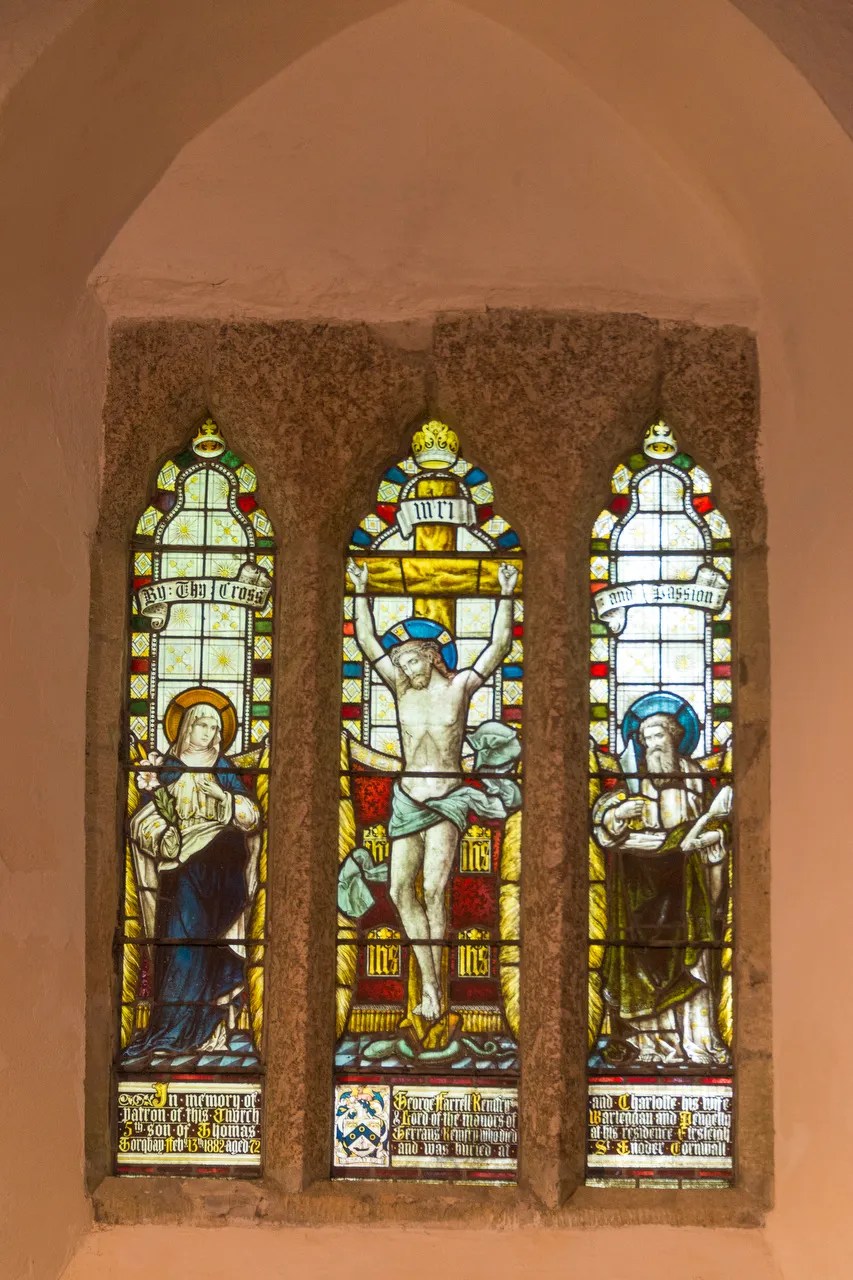
The East Window in St Bartholomew’s Church, Warleggan, Cornwall
This is the text of a sermon preached at St Bartholomew, Warleggan and at St Neot, Cornwall on Sunday 2nd August 2026.
The set readings were, Genesis 3222-31 Romans 91-5 Matthew 1413-21
When I was in my early teenage years, growing up in Bristol, I would often stop off on my way home from school to pop into the County Ground and watch Gloucestershire cricket matches. Around the time I got there, just as they were breaking for tea, admission was free.
Behind and above the ground were the buildings, huge and grey with slate roofs, of the City College. But these buildings had had an earlier life as the Muller orphanages.
George Muller, and his wife, Mary, started caring for orphans in Bristol in 1836, looking after 30 girls in their own home. By 1845 they needed larger premises and started building their orphanages on Ashley Down. As he added more buildings by 1870 they were caring for 1 722 children. A year later that number had increased to over 2000.
The truly remarkable thing about his story, and the growth of his orphanages, is that he never once asked for money, or food or donations of any sort. He prayed and put his trust in God to provide. And, although there were anxious moments, something always turned up.
Now to today’s gospel reading.
John the Baptist has been beheaded and, hearing the news, Jesus seeks to go off to be alone. It’s easy to understand why.
John’s message was a dangerous one. He was openly critical of power, influence and wealth. He made enemies of the very people who could do him harm. The role of prophet has always carried a heavy price – think, among others, of Elijah or Jeremiah.
Jesus is a very different personality to John, but his message is similarly challenging to the rich and powerful. Jesus must know that he runs the same risk and, as well as mourning John’s death, perhaps he needs a little personal space, a little me time, to get his head around what has happened to John and what will very likely also happen to him. We know how his story leads him to his passion and death, and it will not be long, in Matthew’s gospel, before Jesus begins to prepare his disciples for his approaching passion.
But so well known now is Jesus that wherever he goes the crowds follow, and they’re ready for him when he reaches the shore. They’ve got there ahead of him. There is no quiet to be found.
But Jesus is not dismayed. The crowd have followed him and his response is not, as ours would probably be, to try and avoid them, perhaps to vent our anger at being denied those quiet few moments which we so desperately need. No, Jesus responds by taking pity on them and healing their sick.
He shows them compassion, even though he may be as much in need of compassion as they are – there was a reason why he had retreated in the boat to the other side of the lake.
But this is an example of the way that Jesus continually reveals the kingdom for us. He spoke the beatitudes on the mount and now he lives out their implication in many practical situations modelling the mindset necessary to making the kingdom real in the world. He does this time and again in these chapters which follow the Sermon on the Mount in Matthew’s gospel.
Jesus is never a teacher who says, Do what I say, not what I do. He tells us how we should act, but also shows us clearly through his own actions.
And then, what follows is entirely in keeping with what has just happened – Jesus, feeling compassion for them, feeds the crowd.
Evening is coming and as it approaches the disciples of Jesus make an entirely appropriate suggestion, send the people away, and they can go to the villages to buy themselves some food.
That, though, is the world’s solution to what is, admittedly, an easily solved problem. But Jesus needs his disciples to understand the ways of the kingdom. People who need feeding need to be fed, There is no need for them to go; give them something to eat yourselves, he replies. Jesus shows the same compassion towards the hunger of the crowd as he had earlier shown to the needs of the sick for healing.
The story now is so familiar. Over the five loaves and two fish that the disciples have Jesus says the blessing. He breaks the loaves and the disciples share them with the people. When they have eaten their fill the disciples gather up twelve baskets full of the scraps that are left over.
On one level this is a small thing that Jesus has done. He has not solved world hunger. The problem he has solved is a small one indeed. The people are not starving, they’ve just not eaten for a while. They all have their own solution to their need for food. They could return home; they could go to a nearby village and buy food. They could even manage without food for a while longer.
On another level, though, what Jesus does here is truly remarkable.
But the temptation for us is to start asking the wrong question. We immediately want to ask, How did he do that? We’re modern people; we need there to be a rational explanation for what has happened here. But all we can do is speculate. We can never come up with a satisfactory answer – because there isn’t one; or, at least, not one we can find.
All we’re left with is to look at what has happened, and not try to second guess how it happened,
The crowd have followed Jesus.
The disciples have said these people need food.
Jesus says, Let’s feed them then, and see what happens.
And, sharing the food, little though it is, everybody is fed.
How? I’ve no idea, but miraculously everyone at that lakeside was satisfied.
Remember George Muller who I mentioned earlier? He saw a problem – too many orphans without proper care. He decided that his Christian faith, and the kingdom, demanded that he address the problem, which he did, initially by opening his home, and then by building large orphanages. He did what the kingdom of God demanded and trusted that his work would be blessed by God. And indeed it was. Many of the citizens of Bristol supported his work and he never needed to seek help – it just turned up when it was needed.
What Jesus does here is exactly similar. He sees a problem, acts to address it because that is what the kingdom of God requires and God blesses his action. As many as perhaps 10 000 people are fed. The kingdom of God is made real on the shores of the Sea of Galilee, just as it was in Bristol 150 years ago.
It is very tempting for us, being the people we are, when we are faced with a problem to spend a lot of time assessing and planning and making a list of things we need to do before we can even start to address the problem. And often these are the right things to do.
But sometimes it would be best if we just got on with sorting things out.
Mrs Jones at number 24 has broken her leg. Can we fetch anything from the shop?
Fiona’s car has broken down. Can we drop the children off at school/cubs/football?
We can make the kingdom real in all sorts of ways – and wait for God to bless our actions in ways we can hardly begin to imagine.
You get the idea. But sometimes we do need to plan and prepare for things we do, but committing, really committing, is always good at the start if it is something that will make the kingdom real.
Sometimes we can let our anxiety, or fear of failure get in the way of doing the things that make the kingdom real for people in our world today.
We need to learn from Jesus and go for it! and just see where it takes us when God blesses our work – as he does when we are making his kingdom real.
This is the text of a sermon preached at the churches of St Bartholomew, Warleggan and St Neot, Cornwall for the Fifth Sunday after Trinity, July 5th 2026.
The set readings were, Gen 2434-38, 42-49, 58-67 Romans 715-25a Matthew1116-19, 25-end
There’s just no pleasing some people. You know who I mean. Nothing you suggest is ever good enough. Nothing you do is ever what they want. When you ask them what they want to do they say, “Oh, I don’t mind, you choose.” And then, when you take them to the museum they come over all bored and grumpy because they would much rather have gone to a nice garden.
Children, of course, can be like this. And Jesus uses children as an example, not of how annoying children can be. You expect children to be like that. But Jesus makes it clear that he’s talking about how impossible the Pharisees and scribes are to please,
What comparison can I find for this generation? It is like children shouting to each other as they sit in the market place: We played the pipes for you, and you wouldn’t dance; we sang dirges, and you wouldn’t be mourners.
Some children want to play one game, others a different one. They gently mock each other because they can’t agree whether to play weddings or funerals (not games I remember as being particularly appealing) but a squabble has developed over what game to play.
Then Jesus spells it out for the listening crowd,
For John came, neither eating nor drinking, and they say, “He is possessed.” The Son of man came, eating and drinking, and they say, “Look, a glutton and a drunkard, a friend of tax collectors and sinners.” Yet wisdom is justified by her deeds.
John and Jesus bring essentially similar messages but the people who most need to hear that message will not listen and hear what they have to say. John, they say, is too ascetic – a bit of a weirdo, no fun at all, and miserable with it. But Jesus is the exact opposite – a real party animal – and look at him, eating and drinking as if there were no tomorrow. John is too serious – and Jesus, not serious enough. I guess if they’d been somewhere in the middle they’d have been neither one thing nor the other.
But, suggests Jesus, they’re looking at the wrong things. They’re missing the message by being too concerned about the messenger. And in a section omitted from today’s gospel reading Jesus tells them that if the message that both John and Jesus are delivering had been preached in Sodom, and he goes on to list some other, equally sinful, places, they would have repented.
But the good news that Jesus brings is not for the learned and clever; it is for little children. It is for the simple and those who respond with eager faith, those who hear with fresh ears, who are open to what is new and different and exciting – and even, perhaps especially, to what is truly radical.
In Matthew’s gospel Jesus’ first piece of teaching is the great instruction we know as the Sermon on the Mount which begins with the Beatitudes, the blessings on those who are sidelined by the world but who populate the kingdom of Heaven,
How blessed are the poor in spirit… Blessed are the gentle… Blessed are those who mourn… Blessed are those who hunger and thirst for uprightness… Blessed are the merciful… Blessed are the pure in heart… Blessed are the peacemakers… Blessed are those who are persecuted in the cause of uprightness…
These are the first words of teaching from Jesus in Matthew’s gospel. And it feels like this is his manifesto for all that he has to say and do in his ministry on earth. These are the words that will help us to make sense of it all. But they are also words that should set our agenda for how we speak to and serve the world. Words that teach us how we can be growing his kingdom, here and now.
And that is never more true than here as Jesus says,
I bless you, Father, Lord of heaven and of earth, for hiding these things from the learned and the clever and revealing them to little children.
This message, this good news of Jesus – and of John – is entrusted, not to the powerful, or those in authority, or the wealthy, or the clever – they would only mess it up, turn it to their advantage, use it, as they always have to oppress the poor, the weak and the powerless, and to enrich themselves. But the message of Jesus is entrusted to little children or to those who will receive it like a child.
The children, the weak, the simple, the oppressed, the outcasts get what Jesus is saying while the clever and powerful, the wealthy and the influential entirely miss the point. They simply don’t get it. It’s as if Jesus is speaking in an impenetrable foreign language. It makes no sense to them.
The gospel for Jesus is not about what we believe. Jesus wants us to understand that it is what we believe that affects the people that we are. Nothing reveals what our beliefs are more clearly than the way we act towards others.
Do you remember those Beatitudes I spoke of earlier? They are all about turning the world upside down.
The poor in spirit will be invited into the kingdom of Heaven; the gentle shall own the earth; the mourners will find comfort; the victims of injustice will receive justice; the merciful will experience mercy; the pure in heart will see God; peacemakers are the children of God; those who are persecuted will inhabit the kingdom.
All those who are oppressed or weighed down by burdens will find those burdens lifted and be truly blessed.
Our gospel today ends with well known, and loved, words; the Comfortable Words of Jesus,
Come to me, all you who labour and are overburdened, and I will give you rest. Shoulder my yoke and learn from me, for I am gentle and humble in heart, and you will find rest for your souls. Yes, my yoke is easy and my burden light.
This is essentially the same promise that Jesus made in the Beatitudes. Burdens will be lifted, loads shared, rest and peace for all who have never known it before.
The good news that Jesus proclaims is never about what we believe, but about how we behave, how we act, what we do. Because what we do reveals, and shapes, what we believe.
The question we need to ask ourselves is not, Do I believe the words of the creed? Nor is it, Should I read the bible to find out what to believe?
The question we need always to ask ourselves is, Am I easing burdens? Am I sharing loads? Am I sensitive to others needs? Am I concerned for justice? Do I stand up for the oppressed, rejected and outcasts?
Perhaps so that we never lose sight of what is truly important we should stick a copy of the Beatitudes and the Comfortable Words on our fridge doors, or by our coat hooks to remind us that what Jesus wants of us is that we ease burdens, carry loads and turn the world upside down – to live out what we believe and to make a difference in the world.
Come to me, all you who labour and are overburdened, and I will give you rest. Shoulder my yoke and learn from me, for I am gentle and humble in heart, and you will find rest for your souls. Yes, my yoke is easy and my burden light.