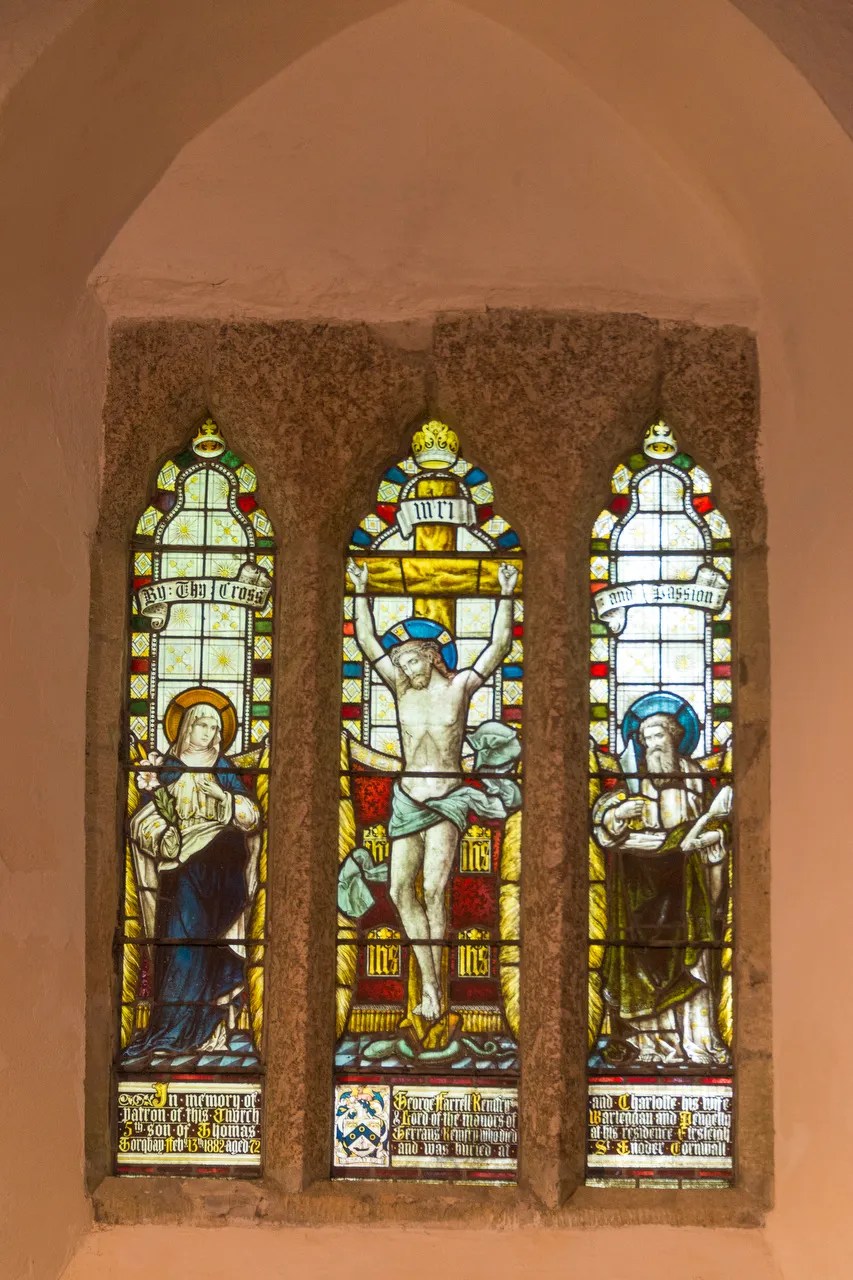
This is the text of a sermon preached at St Bartholomew, Warleggan and at St Neot, Cornwall on Sunday 2nd August 2026.
The set readings were, Genesis 3222-31 Romans 91-5 Matthew 1413-21
When I was in my early teenage years, growing up in Bristol, I would often stop off on my way home from school to pop into the County Ground and watch Gloucestershire cricket matches. Around the time I got there, just as they were breaking for tea, admission was free.
Behind and above the ground were the buildings, huge and grey with slate roofs, of the City College. But these buildings had had an earlier life as the Muller orphanages.
George Muller, and his wife, Mary, started caring for orphans in Bristol in 1836, looking after 30 girls in their own home. By 1845 they needed larger premises and started building their orphanages on Ashley Down. As he added more buildings by 1870 they were caring for 1 722 children. A year later that number had increased to over 2000.
The truly remarkable thing about his story, and the growth of his orphanages, is that he never once asked for money, or food or donations of any sort. He prayed and put his trust in God to provide. And, although there were anxious moments, something always turned up.
Now to today’s gospel reading.
John the Baptist has been beheaded and, hearing the news, Jesus seeks to go off to be alone. It’s easy to understand why.
John’s message was a dangerous one. He was openly critical of power, influence and wealth. He made enemies of the very people who could do him harm. The role of prophet has always carried a heavy price – think, among others, of Elijah or Jeremiah.
Jesus is a very different personality to John, but his message is similarly challenging to the rich and powerful. Jesus must know that he runs the same risk and, as well as mourning John’s death, perhaps he needs a little personal space, a little me time, to get his head around what has happened to John and what will very likely also happen to him. We know how his story leads him to his passion and death, and it will not be long, in Matthew’s gospel, before Jesus begins to prepare his disciples for his approaching passion.
But so well known now is Jesus that wherever he goes the crowds follow, and they’re ready for him when he reaches the shore. They’ve got there ahead of him. There is no quiet to be found.
But Jesus is not dismayed. The crowd have followed him and his response is not, as ours would probably be, to try and avoid them, perhaps to vent our anger at being denied those quiet few moments which we so desperately need. No, Jesus responds by taking pity on them and healing their sick.
He shows them compassion, even though he may be as much in need of compassion as they are – there was a reason why he had retreated in the boat to the other side of the lake.
But this is an example of the way that Jesus continually reveals the kingdom for us. He spoke the beatitudes on the mount and now he lives out their implication in many practical situations modelling the mindset necessary to making the kingdom real in the world. He does this time and again in these chapters which follow the Sermon on the Mount in Matthew’s gospel.
Jesus is never a teacher who says, Do what I say, not what I do. He tells us how we should act, but also shows us clearly through his own actions.
And then, what follows is entirely in keeping with what has just happened – Jesus, feeling compassion for them, feeds the crowd.
Evening is coming and as it approaches the disciples of Jesus make an entirely appropriate suggestion, send the people away, and they can go to the villages to buy themselves some food.
That, though, is the world’s solution to what is, admittedly, an easily solved problem. But Jesus needs his disciples to understand the ways of the kingdom. People who need feeding need to be fed, There is no need for them to go; give them something to eat yourselves, he replies. Jesus shows the same compassion towards the hunger of the crowd as he had earlier shown to the needs of the sick for healing.
The story now is so familiar. Over the five loaves and two fish that the disciples have Jesus says the blessing. He breaks the loaves and the disciples share them with the people. When they have eaten their fill the disciples gather up twelve baskets full of the scraps that are left over.
On one level this is a small thing that Jesus has done. He has not solved world hunger. The problem he has solved is a small one indeed. The people are not starving, they’ve just not eaten for a while. They all have their own solution to their need for food. They could return home; they could go to a nearby village and buy food. They could even manage without food for a while longer.
On another level, though, what Jesus does here is truly remarkable.
But the temptation for us is to start asking the wrong question. We immediately want to ask, How did he do that? We’re modern people; we need there to be a rational explanation for what has happened here. But all we can do is speculate. We can never come up with a satisfactory answer – because there isn’t one; or, at least, not one we can find.
All we’re left with is to look at what has happened, and not try to second guess how it happened,
The crowd have followed Jesus.
The disciples have said these people need food.
Jesus says, Let’s feed them then, and see what happens.
And, sharing the food, little though it is, everybody is fed.
How? I’ve no idea, but miraculously everyone at that lakeside was satisfied.
Remember George Muller who I mentioned earlier? He saw a problem – too many orphans without proper care. He decided that his Christian faith, and the kingdom, demanded that he address the problem, which he did, initially by opening his home, and then by building large orphanages. He did what the kingdom of God demanded and trusted that his work would be blessed by God. And indeed it was. Many of the citizens of Bristol supported his work and he never needed to seek help – it just turned up when it was needed.
What Jesus does here is exactly similar. He sees a problem, acts to address it because that is what the kingdom of God requires and God blesses his action. As many as perhaps 10 000 people are fed. The kingdom of God is made real on the shores of the Sea of Galilee, just as it was in Bristol 150 years ago.
It is very tempting for us, being the people we are, when we are faced with a problem to spend a lot of time assessing and planning and making a list of things we need to do before we can even start to address the problem. And often these are the right things to do.
But sometimes it would be best if we just got on with sorting things out.
Mrs Jones at number 24 has broken her leg. Can we fetch anything from the shop?
Fiona’s car has broken down. Can we drop the children off at school/cubs/football?
We can make the kingdom real in all sorts of ways – and wait for God to bless our actions in ways we can hardly begin to imagine.
You get the idea. But sometimes we do need to plan and prepare for things we do, but committing, really committing, is always good at the start if it is something that will make the kingdom real.
Sometimes we can let our anxiety, or fear of failure get in the way of doing the things that make the kingdom real for people in our world today.
We need to learn from Jesus and go for it! and just see where it takes us when God blesses our work – as he does when we are making his kingdom real.


Leave a comment