Tag: god

  • Should we expect someone else?

    The Church of St Melor, Linkinhorne, Cornwall

    This is the text of a sermon preached at the Church of St Melor, Linkinhorne, Cornwall

    The readings were, Isaiah 351-10 James 57-10 Matthew 112-11

    Are you the one who is to come, or are we to expect someone else?

    This is the question that John the Baptist’s disciples are sent to enquire of Jesus.

    But before we think about this let’s remind ourselves of what John was proclaiming in the wilderness before he was arrested and thrown into prison.

    Repent, for the kingdom of Heaven is close at hand.

    I baptise you in water for repentance, but the one who comes after me is more powerful than I, and I am not fit to carry his sandals; he will baptise you with the Holy Spirit and fire. His winnowing-fan is in his hand; he will clear his threshing-floor and gather his wheat into his barn; but the chaff he will burn in a fire that will never go out.

    John’s message was of the need for repentance, but he knows that he was only preparing the way. After him will come another who will baptise with the Holy Spirit and fire. The one who comes after him will bring judgement. Those who are found worthy, the wheat, will be saved; those who are found unworthy, the chaff, will be sent to eternal fire.

    John is certain of his message and confident that the one who follows will complete his work, bringing in the final judgement, in a way that he cannot.

    The question that he sends his disciples with suggests that he’s not entirely sure that Jesus is the one who will do that. He’s starting to wonder whether this a false dawn. He’s having some doubts – perhaps because, sitting in prison, hearing reports of Jesus from his disciples, he’s become afraid that it’s all falling apart.

    He’s heard what Christ was doing and he’s not sure that Jesus is quite the Messiah he was expecting. And so, the question,

    Are you the one who is to come, or are we to expect someone else?

    The answer that Jesus gives uses quotes from the prophet Isaiah in chapters 35 and 29 where the prophet describes his expectation of the Messiah,

    the blind see again, and the lame walk, those suffering from virulent skin-diseases are cleansed, and the deaf hear, the dead are raised to life and the good news is proclaimed to the poor; and blessed is anyone who does not find me a cause of falling.’

    In his reply to John Jesus clarifies exactly who he is. It is, of course, not just John and his disciples who hear this reply but also Jesus’ own followers – and us. Jesus is fulfilling the scriptural explanation of the identity of the Messiah. Maybe this is the part that John has not fully understood about the Messiah.

    Jesus does bring judgement as the next few chapters of Matthew’s gospel reveal, but for now his primary purpose is to bring hope to the blind, the sick, the disabled and to proclaim good news to the poor.

    John needs to think again about who the Messiah is, and what he is to do. He needs to understand that it’s not all about judgement; it’s also, and vitally, about proclaiming the gospel and bringing hope and renewal to the hopeless and the lost.

    There’s an advert on TV at the moment for a financial advice company which promises to see their clients as individuals and not to put them in a bucket. It’s a slightly odd metaphor but we get the point. This is what John has done with Jesus; he’s put him in a bucket – he thinks he knows what a Messiah should do and therefore is finding it hard to see that Jesus is truly the one he is expecting.

    To use a different metaphor John needs to take the blinkers off and see who Jesus really is. He needs to rethink and reevaluate. He cannot see the whole truth about Jesus because he is only looking for a part of it.

    As we find ourselves in Advent with its focus about preparing and looking for the second coming of Jesus today’s gospel has a timely message for us. What sort of Jesus are we awaiting? Are we ready to allow him to reveal himself to us or are we so sure that we know him that we would not recognise him if he came in a way we were not prepared for.

    There are many facets to Jesus’ life and ministry,

    Jesus the babe of Bethlehem; Jesus in the wilderness; Jesus the healer; Jesus casting out demons; Jesus the teacher; Jesus feeding the crowds; Jesus walking on water: Jesus changing water into wine; Jesus raising Lazarus from the dead; Jesus on the cross …

    You get the idea. You can’t pin Jesus down but so often we try to; we can so easily put him into a bucket.

    It’s good therefore from time to time to review what we believe about Jesus. And Advent is as good a time as any to do that. In the days leading up to Christmas as we think about what it means for us that Jesus came as a baby in Bethlehem we can challenge ourselves to think deeply in our prayers about what it means for us that God’s Son became human and lived among us as God and man.

    We need to ask ourselves in what ways Jesus challenges us. Perhaps we don’t feel challenged by him. But I believe that we should. If we’re not challenged by him we’re not really listening to him. Jesus challenged everyone who met him.

    Some were challenged to realise that their lives were going in a wrong direction – Zacchaeus the tax collector, Nicodemus, the Pharisee who came to him by night. Some were challenged to see themselves as valued and loved by God – the woman at the well, those possessed by demons or with disabilities. Some were challenged to see themselves as people who could be used by God – the twelve disciples. Some were challenged to reevaluate their lives – the rich young man.

    If we don’t see ourselves as challenged to be changed, to be transformed, by Jesus it may be that we have put him in a bucket which makes us feel safe and affirmed by him, but also makes us deaf and blind to what he is calling us to become.

    We can use this time of Advent to take him out of the bucket and let him reveal himself afresh to us. Jesus continually renews us and takes us in new directions.

    He is always revealing new things about himself – and about us. To learn from him we need to be ready to see him as he is revealing himself to us each day and hear him as he speaks to us the new things he is revealing to us.

    We must never assume that we already know him. He is never unknowable for he is always revealing himself to us. What gets in the way of our knowing him is us. It’s us believing we already know who he is.

  • Christ the King

    Interior view of St Tallanus Church

    The text of a sermon preached in the Church of St Talannus, Talland, Cornwall on Sunday 23rd November 2025, the Feast of Christ the King.

    The readings were, Jeremiah 231-6 Colossians 111-20 Luke 2333-43

    Jesus, remember me when you come into your kingdom.

    The words of the thief as he hangs with his companion and Jesus on their crosses.

    Today we celebrate the feast of Christ the King. It might seem strange therefore that our gospel reading recounts events from the crucifixion of Jesus. Hardly what we would expect to be how Jesus’ kingship is most clearly revealed.

    And yet, everybody in this account seems to be obsessed with what kingship might mean for Jesus.

    In the verses before those we heard read this morning we hear how the Jewish leaders brought Jesus before Pilate and make this charge against him,

    We found this man inciting our people to revolt, opposing payment of the tribute to Caesar, and claiming to be Christ, a king.

    Jesus they say claims to be a king – and therefore a threat to Roman authority.

    Pilate, finding no case against him sends Jesus to Herod. Herod questions him but Jesus is mute. Herod and his soldiers dress him in rich clothes, as if he were a king, and mock him, as if to say, Call yourself a king? You’re a nobody.

    Returning to Pilate Jesus is condemned and led away to be crucified. Again he is mocked, first by the Jewish leaders,

    He saved others, let him save himself if he is the Christ of God, the Chosen One.

    In their eyes these words,the Christ of God,make Jesus a king. They are challenging him to use his kingly power to save himself from the cross.

    The soldiers crucifying him mock him, saying,

    If you are the king of the Jews, save yourself.

    Then they crucify him and place the inscription above him on the cross,

    This is the King of the Jews.

    They too jeer at Jesus because he seems a poor imitation of a king. He has no power to prevent his execution. He has none of the trappings of a king. He has no army, no subjects, no power, no authority, no palace, no kingdom, no respect. He is at their mercy, a feeble and condemned man with no hope.

    And then there’s the first thief. In spite of his own suffering he mocks Jesus from the cross,

    Are you not the Christ? Save yourself and us as well.

    Perhaps there’s the merest hint of a hope that it might be true, but ultimately it’s just another insult like all the others, Some king you turned out to be.

    And finally there’s the second thief,

    Have you no fear of God at all? You got the same sentence as he did, but in our case we deserved it: we are paying for what we did. But this man has done nothing wrong. Then he said, Jesus, remember me when you come into your kingdom.

    Jesus replies,

    In truth I tell you, today you will be with me in paradise.

    At last, someone who gets it. Of all the characters in the whole account of the passion in Luke’s gospel only the second thief sees who Jesus truly is.

    He sees the same man who has been arrested, tried, condemned, mistreated, scourged, crucified and who now hangs, a pathetic figure, dying on the cross but also sees – a King.

    He alone sees that Jesus’ kingship has nothing to do with rich clothes, fine palaces, servants, armies, power or territory.

    He alone sees that the floggings, the mocking, the condemnation, and the crucifixion are necessary for Jesus to enter into his kingdom. Where everybody else thinks that the crucifixion and Jesus’ inevitable death marks the end of Jesus’ fortunes, the good thief sees that this is just the beginning. This death leads to resurrection and the salvation of all who believe in him.

    Jesus is not the sort of king, the Jewish leaders, the Roman soldiers, the crowds expect. He is a king who lays down his life for all who believe in him and brings them into his kingdom; a kingdom unlike any other for Jesus Christ is a king unlike any other.

    It is now that Jesus is entering into his kingdom. And with him the good thief. And following them all who know that Jesus is the King. This is not an end, but a beginning.

  • Love v Scripture

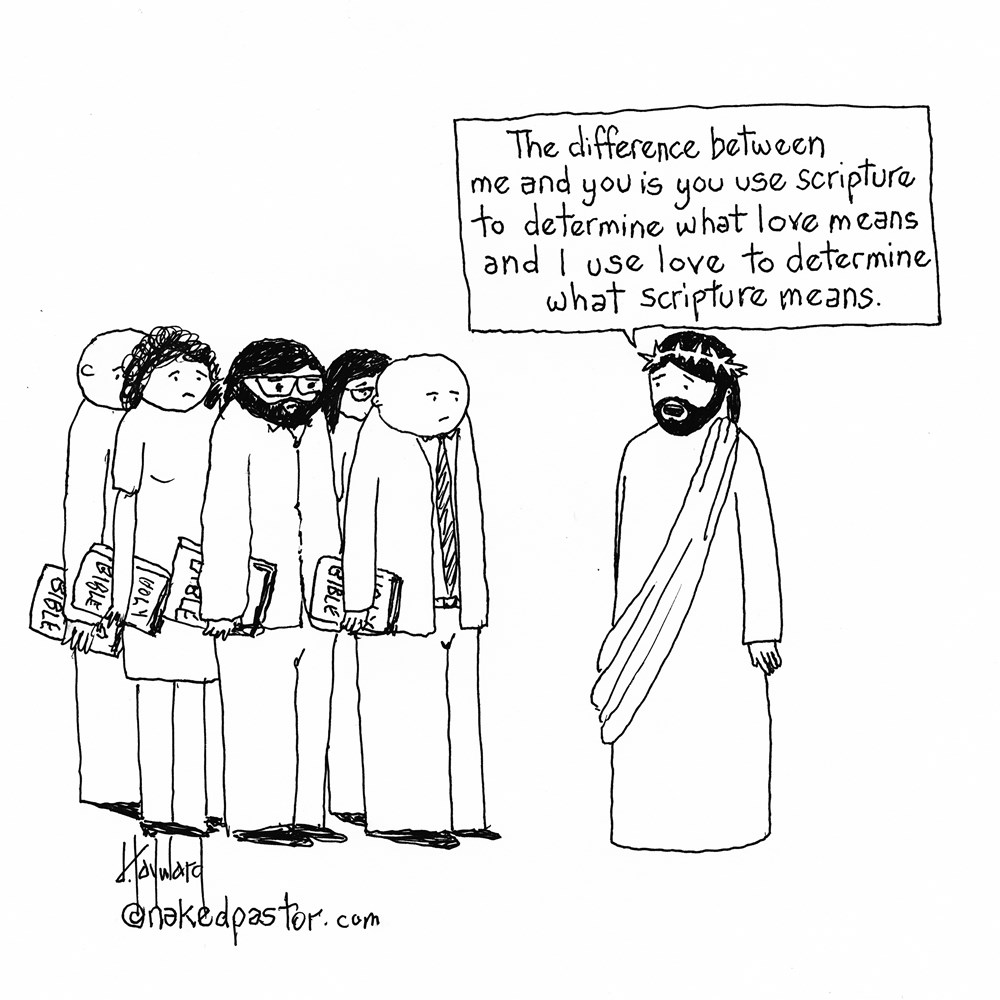
    The cartoon above appeared in the Church Times on 7th November 2025

    How we use scripture is crucial to our mission and to our personal growth in faith. It is one of the ways that God shapes us as Christians.

    For Christians scripture, the Bible, has authority. In the Church of England it is believed that scripture has authority for the establishment of doctrine (The Thirty Nine Articles of Religion, Article 6, Of the Sufficiency of the Scriptures). Nothing can be established as essential to be believed unless it can be justified by scripture. The faith as outlined in the Creeds fall into that category – they don’t require us to affirm anything that cannot be justified by scripture.

    That all seems very simple – we believe what scripture teaches us. Reading the Bible should tell us everything we need to know.. When we read the Bible it will clearly reveal the God-given truth to us. But, of course, it is never that simple.

    The moment we open the Bible to read it, in the privacy of our home or in the worship of the Church, we interpret what we read. We bring our own context to it.

    When preaching I often (almost always) say when trying to understand a biblical text that context is key. But I do not refer only to the context in which Jesus said the things he said, or did the things he did, but also in the context in which we read the text.

    It is almost always a mistake to read a verse from the bible in isolation. Think of John 13.14,

    If I, then, the Lord and Master, have washed your feet, you must wash each other’s feet.

    If we read that single verse and tried to apply it in our own lives even our Christian friends would think us a little odd. Out of context it is an instruction to literally wash each others feet; but in the context it is about becoming the servants of each other and about treating each other with humility and generosity.

    If I were to read that single verse with the wish to find out what Jesus wants me to do (my context for reading) then I shall want to be washing feet. But if I read it wanting to find out how Jesus wants me to respond to my Christian companions it will tell me so much more.

    This, broadly speaking, is the message that this cartoons gives. In the one case we would be using scripture to find out what love means. In the other we would be using love to determine what scripture means.

    This is just a single example but the point, I think is well made. The bible doesn’t so much tell us what love means, but love tells us what scripture means. Scripture reveals so much more when we come to it not looking for answers but for guidance; not so much looking for instruction as for clues as to how to work out our discipleship for ourselves.

  • Hidden truths and parables

    Church tower of St Bartholomew’s, Warleggan

    The text of a sermon preached at St Bartholomew’s Church, Warleggan and at St Neot, Cornwall on Sunday 19th October 2025

    Today’s readings were, Jeremiah 3127-34 2 Timothy 314-45 Luke 181-8

    Why did Jesus use parables when he was teaching the crowds who came to hear him?

    Right now you’re probably thinking something like, He told colourful stories to teach us about the kingdom of God, or To reveal what God wants us to do and to be.

    But if that’s all he’s doing, why doesn’t he just tell us? Why doesn’t he say something like, The kingdom of God is like a place where everybody just gets on with each other, where everybody is supported and cared for by everybody else, where no one cheats, or lies, or hurts other people; be the sort of people who can make that happen, but he doesn’t; he tells us about a good Samaritan, or a prodigal son, or about the wise and foolish bridesmaids, or about sheep and goats, or, as this morning, about a corrupt judge and a persistent widow.

    There’s more to parables than telling us about the kingdom or about God. There are clues in the gospels to tell us why Jesus uses parables and we find one in Luke’s gospel when Jesus’ disciples ask him what the parable of the sower means, and he replies,

    To you is granted to understand the secrets of the kingdom of God; for the rest it remains in parables, so that

    they may look but not perceive,
    listen but not understand.

    So parables are used both to reveal and to hide the truth. Reveal it to those who are ready to hear but to hide it from those who are not.

    We might say that the truth of Jesus’ teaching is revealed only to those who are prepared to reflect upon what he says, to mull it over, to think deeply about it.

    Now, it has to be admitted that some parables are easier to understand than others – the good Samaritan and the prodigal son are pretty straightforward for us to make sense of, but others are much trickier.

    Today’s parable falls into that second category. It’s not immediately obvious what the truth is that is being revealed.

    At a first reading it seems as if Jesus is telling us that it is by pestering God in prayer that we get the response we want. But a moments thought tells us that this cannot be right. God cannot be badgered into doing what we want. Prayer surely doesn’t change God – it changes us!

    So we must look a little closer and think again and we see other themes, some of which we can easily relate to.

    The widow has clearly been cheated. We don’t know how. Perhaps she has been swindled in the market place, or a workman has failed to do the work that he promised and she paid for, perhaps a neighbour has borrowed a precious possession and now refuses to return it. Maybe an official has been exploiting her for his own gain. We don’t know and it doesn’t matter – she has clearly been wronged and it seems quite likely that someone with power has taken advantage of her vulnerable status as a widow. And now the judge is adding wrong to wrong. However, her persistence pays off and justice is granted.

    So we have a story with a satisfactory ending, but what does it teach us about God and about the kingdom?

    In the character of the judge we can surely detect a warning about what is not acceptable to God. His actions remind us that there are people who exploit the vulnerable and the needy. They use their power and authority for their own advantage and not for the good of the society In which they live. His actions remind us that there are many vulnerable people who can easily be taken advantage of and that those people deserve justice, support and care – no less true today than in the time of Jesus.

    It reminds us that God is on the side of the weak and powerless. He sides with the poor. This message is reinforced time and again in Luke’s gospel.

    In the parable of the prodigal son we can see, in the father, God with his readiness to forgive; we can see ourselves in the brother with his bitterness and jealousy. The lesson here seems clear. These associations that we make help us to get inside the story and make sense of it.

    In today’s parable, though, we cannot see God in either of the characters in the same way. He cannot be seen in the actions of the judge – God does not act so unjustly, nor does he withhold or delay justice in this callous fashion. So we have to conclude that this parable teaches us little about God or the kingdom. It seems more a case of teaching us what the kingdom is NOT like rather than what it is like. So we must look elsewhere.

    Neither can we very fruitfully put ourselves into the story. Doing so might give us some insight into how the judge and the widow experience the story but it’s not gong to provide a key to unlock the message for us.

    In the previous chapter Jesus has been warning his disciples what the Day of the Lord will be like.

    He’s warned his disciples not to be fooled by false alarms about the end. It will come at an unexpected moment, some will be taken, others left; it will be awful and sudden. Therefore they need to be in a continual state of readiness for it.

    This is the context in which he delivers this parable and Luke helps us to unpack its meaning by his introduction to it,

    Then he told them a parable about the need to pray continually and never lose heart.

    The widow is commended to us because of her persistence. She goes back to the judge again and again until he gives in and grants her the justice she deserves – even if it is not done out of the noblest of motives. He does it because he fears that she will wear him out with her persistence (although that phrase could mean that she might slap him in the face – the widow becomes, for the judge, a formidable and even terrifying adversary!)

    Her persistence reveals the same attitude that we need to prayer. Not because God needs persuading, but because we need not to lose sight of our final goal. The woman is entirely focussed on getting justice and so persists. We should be entirely focussed on our place in the kingdom, and our readiness for the Day of the Lord. The way to do that is through prayer – by continually putting ourselves in God’s presence, not because of what that does to God, but because of what it will do to us. And what it should do to us is to drive us to action. Prayer can never be a passive exercise.

    That constant prayer will ensure that we are always ready for the Day of the Lord. It will ensure that our focus, our attention is in the right place – on God and on responding to his love by the way we live and interact with those among whom we live.

    Because this is not just about being reflective and prayerful – this is about God’s justice and our response to injustice in the world. It is about being empowered by our prayer and making the kingdom present. Because our prayer means nothing if it changes nothing. It is about whether we stand with and for God – and especially with the weak and vulnerable – or with the world

    This parable is a challenge to us to pray continually and to make God and his kingdom present in the world today.

  • Increase our faith

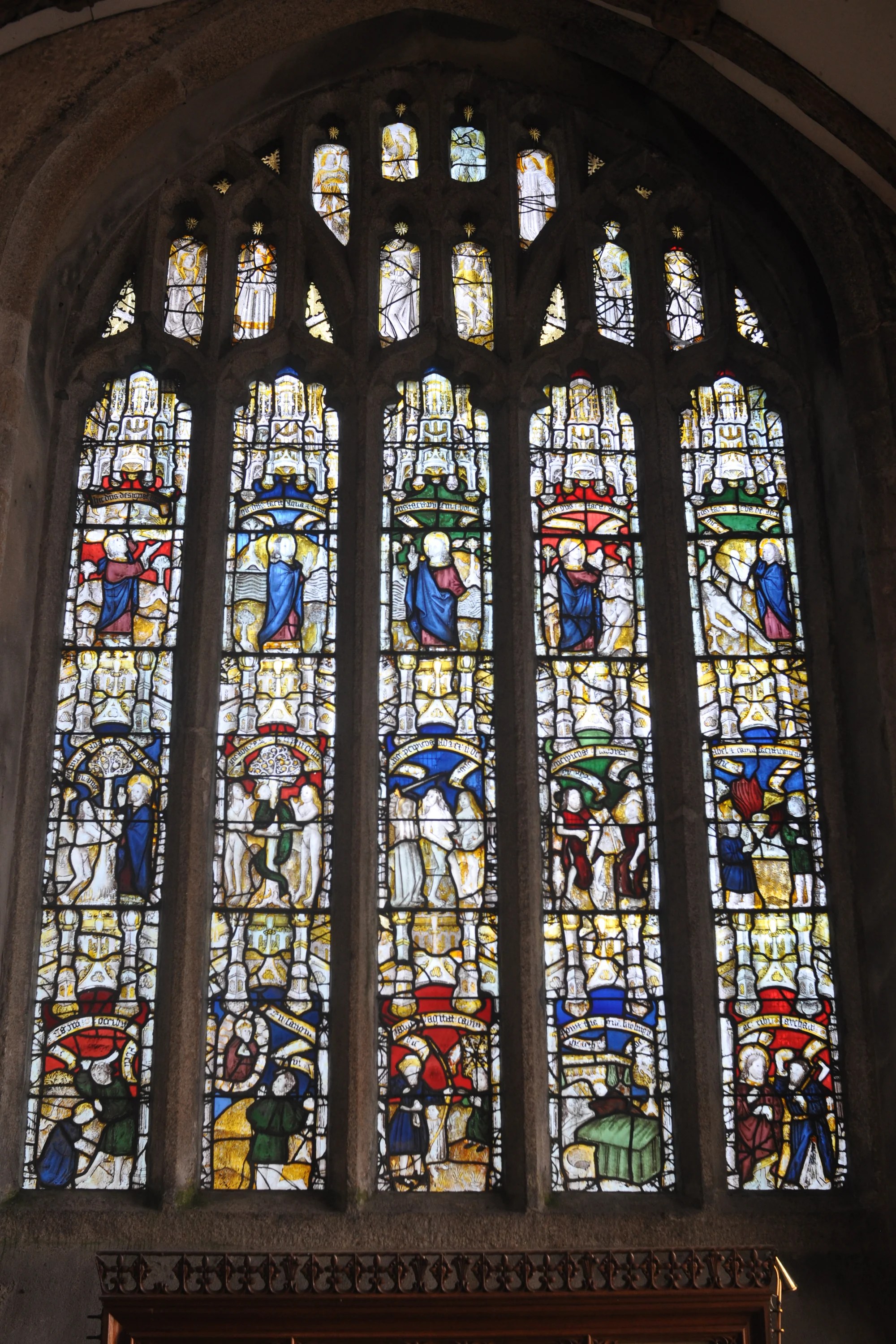
    The Creation window in St Neot Church, Cornwall

    This the text of a sermon preached in the Church of St Neot, Cornwall on Sunday 5th October 2025

    The readings were, Lamentations 11-6 2 Timothy 11-14 Luke 175-10

    The apostles said to the Lord, “Increase our faith.”

    Surely as we hear the apostles’ plea that Jesus should increase their faith we have sympathy. If only we had more faith the things we could do; we could fill our church every Sunday; the ways we could change the world; the help we could give to those in need; the people we could heal; the peace we could bring to the world; how ready to forgive we would be; how easy it would be to plant a mulberry tree in the sea. Well, maybe that last one is not on the list of things we think we could do with more faith but Jesus seems to suggest that it would be possible if only we have faith the size of a mustard seed.

    Jesus’ response to the apostles’ request is clearly absurd – another example of his use of hyperbole. But he’s making an important point to them – and to us!

    Think of the context in which this exchange happens. Jesus is on his way to Jerusalem. He has been exercising his ministry in Galilee for almost three years. He has been travelling to Jerusalem by stages for, perhaps, several weeks. His disciples have been with him for all that time watching him and listening to him, learning from him and asking questions of him for the whole of those three years.

    In the verse before this morning’s gospel passage Jesus has told them,

    If your brother or sister does something wrong, rebuke them and if they’re sorry, forgive them. And if they wrong you seven times a day and seven times comes back and says, “I am sorry,” you must forgive them.

    It appears that this is what provokes the request for more faith. They feel that they have not enough faith to be able to forgive that often, that much. Indeed, Jesus is not telling them that forgiveness is easy, nor that it can ever be cheap to forgive – or receive – forgiveness. But he does want them to understand that forgiveness is a prerequisite for the faithful; it’s not negotiable – so they feel they need more faith to be able to fulfil that demand of ready forgiveness.

    We understand how they feel. We know that forgiveness is not easy – especially when we feel wronged time after time. If repentance appears only to be said and not sincerely meant it seems natural and right to withhold forgiveness – but remember, on the cross Jesus forgave his persecutors not because they were sorry but because they were ignorant of the wrong they were doing, Father, forgive them; they do not know what they are doing.

    There can be no excuse for being unprepared to forgive, so the apostles and we are wrong to believe that we need “more faith.” And that is what Jesus tells them when he says, If you had faith like a mustard seed you could say to this mulberry tree, “Be uprooted and planted in the sea,” and it would obey you.

    I don’t believe for a moment that Jesus intended us to take that literally.

    It’s as if Jesus is saying, What! You’ve been with me for three years. Are you saying that you do not even have faith the size of a mustard seed? It’s tiny. And even faith that tiny can uproot a tree and plant it in the sea.

    He’s saying that even a tiny amount of faith can achieve remarkable things. He’s telling us that we have enough faith to do the things that need to be done – even forgiving our brother or sister seven times a day!

    There are many things that we feel that we are not good enough to do for the Lord. There are things that we feel that we could do if we had a stronger faith, things we could achieve if only God would pour out his Spirit on us.

    But we’re wrong. We do have enough faith to do those things. We’re just using lack of faith as an excuse. It’s not lack of faith; it’s a lack of enthusiasm, a lack of energy, a lack of commitment, a lack of time – or making time.

    We always have an excuse for why we are not achieving the things that we feel we should be achieving. Always waiting for God to do something to help us to do what we know he wants us to do.

    That’s what this saying means – even the tiny amount of faith we have is enough to move mountains, if we’ll let it.

    This same thought appears also to drive the thinking of Paul when he writes to Timothy in this morning’s New Testament reading,

    I am reminding you now to fan into a flame the gift of God that you possess … God did not give us a spirit of timidity, but the Spirit of power and love and self-control.

    We know no details of exactly why this was written but it seems that Timothy needs to be reminded that he already possesses the gifts from God that he needs for the challenges that face him. Paul has already mentioned the faith that he has – handed down from his mother and grandmother, Eunice and Lois.

    Paul wants him to know that what he has is enough so, he continues,

    You are never to be ashamed of witnessing to our Lord … but share in my hardships for the sake of the gospel, relying on the power of God who has saved us and called us to be holy.

    Paul here encourages Timothy and reminds him of the God-given gifts he has but never suggests that he needs more – not more faith, not more gifts. What he has is sufficient. Although what he is called to do may not be easy it will not unachievable because he does not have the resources of faith, character or ability that he needs. It will be timidity or fear that holds him back.

    Paul and Jesus agree – those who have faith have the gifts they need to perform the service God requires of them. Lack of what God provides is not the cause of our failure to succeed in the tasks assigned to us; it is our inability to recognise and use those gifts. You might call it a lack of confidence.

    We have all we need. We just need to be confident in the gifts of God.

  • Peace, which passes all understanding

    This is the text of a sermon preached at St Wyllow’s Church, Lanteglos, Cornwall on Sunday 17th August.

    The readings were, Isaiah 51-7 Hebrews 1129-122 Luke 1249-56

    Do you suppose that I am here to bring peace on earth?

    I guess if Jesus were to ask us this question today we would probably answer, Yes! and with some certainty; after all when his birth was proclaimed by the angels they promised in their song to the shepherds of there being, on earth peace among people of good will.

    And we think immediately of Jesus as the Prince of Peace. We think of the words of the blessing that we so often use, The peace of God which passes all understanding. We think of the peace that we share in our celebration of the eucharist.

    We are so used to thinking of Jesus as the one who brings peace to us that this passage that we heard read today from Luke’s gospel falls strangely on our ears. It seems really odd, not quite right, to think of Jesus as the one who brings dissension, disharmony and division. That is not how we believe it should be; and yet, this is what Luke tells us that Jesus said.

    And here we are presented with these challenging sayings of Jesus,

    I have come to bring fire to the earth.

    Do you suppose that I am here to bring peace on earth?

    …from now on, a family of five will be divided: three against two and two against three.

    It’s easy to gloss over passages such as this when we’re sat at home reading the gospel in our armchair. Today though it is our gospel reading, it sits at the very heart of our worship so we have to notice it and think about it.

    At the end of this passage Jesus challenges his hearers with the words,

    How is it you do not know how to interpret these times?

    Perhaps that is where we should start. How do we interpret the signs of our times? What do we make of the world of which we are part?

    Jesus has already given us clues in Luke’s gospel. If you look at the context in which this saying appears we will see warnings about being ready for Jesus’ coming, advice about the right attitudes to wealth and the importance of almsgiving.

    There have also been warnings about the importance of avoiding hypocrisy, and not behaving like the Pharisees.

    Everything in Jesus’ world is not straightforward. The world is messy and people’s priorities are not always in the right place.

    Of course, all of this sounds familiar to us in our own time. Our world is messy too.

    It will be a common experience for you to have had conversations with colleagues, friends or neighbours about the state the world is in. We live in times which make positivity difficult; and despair easy to fall into.

    Wherever we look we are more likely to see anxiety than hope. And we certainly find that agreement about anything seems unattainable. Ours is not a society in which discussion brings any consensus. Divisions appear to be more and more deeply entrenched – with no obvious way out. We seem to find it increasingly difficult to be able to agree to disagree.

    And that does not feel a million miles away from what Jesus is talking about here,

    …from now on, a family of five will be divided: three against two and two against three.

    Is he saying to us, This is how the world is? You have to decide what is the right thing to do; the right person to be. And, that will set you apart from the world, from your family, your friends, your neighbours.

    Jesus is preparing his hearers to be set apart from the world. The division he is talking about occurs because his way is always in conflict with the way of the world. We cannot be his followers unless we are prepared to stand apart from the world.

    Indeed, this was often the experience of the earliest Christians. Although we read in the Acts of the Apostles and in Paul’s letters of families, or households being converted it was surely at least as common for individuals who chose the Christian way to be rejected by their family, or their synagogue, or their community.

    The Jews were suspicious of Christians and the governing Romans were wary too of the impact on good order that large numbers of converts might have.

    So this saying about sowing division might be included here by Luke to reassure those Christians who were living through this very experience – Jesus understands what you might be going through, he predicted it, even to the point of division within families..

    Perhaps, when Jesus speaks of bringing fire to the earth we should think not just of the destructive force of fire, but of the positive effects of fire as well.

    Often fire in scripture is spoken of in the context of judgement or purifying. And again it is an image of the coming of the Holy Spirit, as we see in Luke’s other work, the Acts of the Apostles.

    So, has Jesus come to bring peace to the earth? Or is the peace he has come to bring to be found somewhere else?

    Although these words appear deeply challenging and disturbing, they also bear a significant degree of positivity.

    There will be division – it’s inevitable; there will always be people who are not ready to hear the good news and accept it. There will always be persecutors, critics and doubters.

    The fire of judgement will reveal those who are found wanting and who will be rejected; but there will be many who are filled with the holy fire of the Spirit and those who are cleansed and renewed by it.

    So, there will be peace on earth – for those who welcome it. But not everybody will. Those who make the wrong choice will pay the price for their poor decision. But Jesus here is warning us that the choices we make matter.

    Psalm 34 has encouraging words for us,

    Turn aside from evil and do good.
    Seek after peace and pursue it.

    The Lord turns his eyes to the righteous,
    and his ears are open to their cry.

    The Lord turns his face against the wicked
    to destroy their remembrance from the earth.

    When the righteous cry out, the Lord hears,
    and rescues them in all their distress.

    (Ps 3415-18)

    Whether Christ brings peace on earth depends on the choices we make. The peace is there for us if we are ready to see and seize it.

  • Keeping our eye on the ball

    This is the text of a sermon preached at St Nun’s Church, Pelynt on Sunday 10th August 2025

    St Nun’s Church, Pelynt

    The readings were, Isaiah 11, 10-20 Hebrews 111-3, 8-16 Luke 1232-40

    Where your treasure is, that is where your heart will be too.

    When I was learning to play cricket, a sport at which, for all my enthusiasm, I never really excelled, it was drummed into me that I should keep my eye on the ball. It was good advice too, even if I did occasionally fail to follow it. Taking one’s eye off the ball could result in a dropped catch or the ball whizzing past to the boundary, or, if batting, the dreadful clatter of wickets might well follow quickly. But there was more personal danger too. The cricket ball is very hard, and moves at pace; taking your eye off the ball can be very painful!

    In this morning’s gospel reading Jesus is giving his disciples similarly urgent advice. Indeed, so urgent is his advice that he repeats various versions of it three times.

    Where your treasure is, that is where your heart will be too.

    Blessed are those servants whom the master finds awake when he comes.

    You must stand ready, because the Son of Man is coming at an hour you do not expect.

    Jesus is clearly urging his disciples to remain focussed, to keep alert and always to be watchful. We need to ask though what exactly is it that we need to be so prepared for. And, it is not just one thing.

    The first of these warnings is not about something unexpected. It is a warning about being focussed on the right things. Having assured his disciples that the Father has given the disciples the kingdom Jesus continues to warn them of the conditions on which the kingdom is bestowed,

    Sell your possessions and give alms. Get yourselves purses that do not wear out, an unfailing treasure in heaven, where no thief comes near and no moth destroys.

    This is a development of last week’s warning that life does not consist in abundance of possessions, and the message against storing up wealth for ourselves rather than becoming rich with regard to God.

    Luke’s gospel has a great deal of emphasis on the dangers of hoarding riches rather than using them for the relief of poverty.

    Here we are clearly warned to amass our treasure, not in worldly wealth, but in heaven. And the way to do that is through giving alms, charity to relieve poverty and protect the vulnerable.

    Although we have the kingdom given to us it is a gift we can easily lose it by neglecting our duty, as Christian believers, to care for the poor and vulnerable in our society.

    The second warning is to keep awake for the return of the master from the wedding feast. Traditionally, this passage has been interpreted as urging us to be ready for the second coming of our Lord – and that is certainly the main focus.

    But it is what Jesus says that the master does when he arrives that I want to reflect a little on today.

    The master does not demand his servants wait on him, but he will do up his belt, sit them down at table and wait on them.

    This is a radical saying from Jesus. It is a complete reversal of the roles of servant and master. This surely recalls a saying of Jesus that comes a little later in Luke’s gospel (2227),

    For who is the greater: the one at table or the one who serves? The one at table surely? Yet I am among you as one who serves!

    Although the anticipation of the second coming is clear, we do, perhaps, see here too a reference to what happens when Christ comes to us in the sacrament of holy communion. Here he, our Lord, serves us as we rejoice in his presence among us.

    So it may be that Jesus is warning his disciples to be ready to welcome him in the sacrament.

    So this brief paragraph might have a double meaning for us, as for the readers of Luke’s gospel nearly two thousand years ago.

    And when Jesus talks about the master’s coming in the middle of the night, or when it is nearly dawn is he warning us that there could be moments when he will arrive unexpectedly – perhaps in the guise of someone in need?

    The third warning is very similar to the second. It seems a strange warning though. Clearly the emphasis must be on the unexpectedness of the Son of man’s coming, for surely we do not dread it in quite the same way as we might dread the appearance of a thief in the night.

    I think that the point Jesus is making is that being unprepared for his coming would be as disastrous for us (and possibly more so) than failing to secure our home against burglars. Perhaps Jesus is telling us to be as concentrated on protecting our place in the Kingdom as we are on protecting the place where we live.

    These three brief sayings contain much for us to consider. Are we focussed on the right things? Is our concern more for ourselves and our own comfort and security than it is for others? Particularly, are we using the gifts that we have been given in the service of the poor and needy, or are we simply storing them for a rainy day?

    Are we committed to being ready for the time when Christ comes to us? Not just at the second coming, but in the sacrament, and in the needy, broken or lonely.

    Is our life directed towards the Kingdom of God, or are we so consumed by the needs of this life that we neglect our place in God’s kingdom.

    These sayings of Jesus remind us to review our priorities and make sure that our heart is in our heavenly treasure, and not distracted by our earthly concerns.

  • Lord, teach us to pray

    This is the text of a sermon preached at St Tallanus Church, Talland, Cornwall on 27th July 2025

    St Tallanus Church, Talland

    Hosea 12-10 Colossians 26-15[16-19] Luke 111-13

    Lord, teach us to pray,

    When I was confirmed almost sixty years ago my parish priest gave me a little book,In His Presence– a sort of handbook of how to live a Christian life. It’s first instructions were about how to pray and to make prayer a central part of my discipleship. My prayers, it said, should follow the acronym,

    Adoration – love, adore and praise God

    Confession – we confess our sins and ask God’s forgiveness

    Thanksgiving – we give thanks to God for the blessings of our life

    Supplication – we pray for the needs of others or of ourselves

    ACTS, ACTS of worship

    Jesus here, in response to his disciples’ request, teaches his disciples what we know as the Lord’s Prayer. Although, this version, from Luke’s gospel is different to that found in Matthew’s gospel, the prayer that Jesus taught his disciples does everything we need to do in prayer.

    It defines the relationship that we have with God. It stresses our need for God and all that he provides for us. It leads us to beg forgiveness and reminds us of our responsibility to be forgiving of others ourselves. It pleads with God to be present to save us from times of test and temptation.

    And now in a little more detail.

    Luke’s version begins with the single word Father. There’s no invocation such as Almighty God, Heavenly King, Lord of Creation nor anything else that stresses the greatness of God compared to our own insignificance. It’s a title of God which emphasises the closeness of our relationship with him.

    When Jesus tells us to pray, Father, he is reminding us, every time we pray that we are in a loving relationship with God. Matthew’s version Our Father in heaven puts a little distance between us and the Father – still the relationship but God is a heavenly Father.

    We know that Jesus spoke often of God as his Father, and that he even used the word Abba which is similar to daddy. So, we know that this form of address is all about the closeness and tenderness of the relationship.

    God is a god to whom we can take our concerns, our problems and our most intimate worries, and who is ready to listen and show us the love that can build us up and heal us.

    Father, may your name be held holy,

    we know that holiness is an attribute of God, and the very act of praying reveals that we already hold God to be holy. We’re not praying that we ourselves will hold God holy, but that God will be held universally to be holy.

    This prayer is surely about God being revered for who he is throughout the world, so this prayer is a prayer to make God known and therefore is a challenge to us, and a statement of our intention to make God known.

    Father, may your name be held holy,
    your kingdom come;

    When God is known he will be acknowledged as King; his kingdom will come.

    Those of us who know God as Father and hold him holy are already members of his kingdom. When God is universally held holy the kingdom will also be universally present.

    Father, may your name be held holy,
    your kingdom come;
    give us each day our daily bread,

    Now we pray for what we need to live, but also to be disciples of Jesus. Each day in Luke’s prayer is different to Matthew’s today or this day. We ask that God’s provision of our needs is renewed day after day. It is about a covenant relationship between us and God. We call on the relationship, and commit to making God known. We pray for the spread of the kingdom and ask God to sustain us – physically and spiritually.

    Father, may your name be held holy,
    your kingdom come;
    give us each day our daily bread,
    and forgive us our sins,
    for we ourselves forgive everyone who is in debt to us

    we know that forgiveness can never be only something that we receive, but something that we must give too. Indeed, being forgiven is conditional upon us being forgiving. Showing forgiveness makes a huge difference in our world. It reveals the truth that resentment and vengeance are damaging to relationships and that forgiveness allows them to flourish. It heals our own relationships, but it heals the wounds in society too.

    Father, may your name be held holy,
    your kingdom come;
    give us each day our daily bread,
    and forgive us our sins,
    for we ourselves forgive everyone who is in debt to us.
    And do not put us to the test.

    And finally, a prayer that we will not be put to the test, not tempted beyond what we can endure and resist. Luke is concerned, especially in his Acts of the Apostles, for those Christians who are not able to remain faithful and the prayer has Jesus telling us to pray not to be tested that we may remain faithful.

    The Lord’s prayer, as Luke records it (or, indeed, as Matthew records it), says all that needs to be said to reinforce and build up our relationship with God. It commits us to a deeply Christian way of living, and reminds us daily of God’s commitment to us.

    The Lord’s Prayer though is very much about our relationship with God. It’s all about getting that relationship right so that we can grow as faithful followers of the Christian way.

    What it doesn’t do is give a us a model for praying for others. However, it does make clear that we can take our needs and concerns to God, and that, because of the relationship we have with God, he is ready to hear and respond to those needs and concerns.

    If we are concerned about our neighbour who is housebound and lonely; if we are worried about our grandchild who is ill; if we’re anxious about our daughter’s difficult marriage; if we’re alarmed about the situation in Gaza; if anything at all, no matter how important or trivial it might be, we know that we can take those concerns to God in prayer and he is ready to hear us and will answer us – although how God answers prayer is whole other sermon.

    Lord, teach us to pray,

    When you pray, this is what to say:

    Father, may your name be held holy,
    your kingdom come;
    give us each day our daily bread,
    and forgive us our sins,
    for we ourselves forgive everyone who is in debt to us.
    And do not put us to the test.

  • Peace, But Not as the World Gives

    This is the text of a sermon which was preached at St Neot on the Sixth Sunday of Easter

    These were the readings Acts 169-15 Revelation 2110, 22-225 John 1423-29

    Peace I leave with you; my peace I give to you. I do not give to you as the world gives.

    We saw a few weeks ago that Jesus greeted his disciples, on the day of his resurrection, in the upper room with the words, “Peace be with you.” He did it again the following week when Thomas was present with them. Paul greets the churches he writes to with the word “peace.” He does so in his letters to the Romans, both of his letters to the church in Corinth, to the Galatians, to the Ephesians; in fact every one of his letters begin with that greeting. It was a conventional greeting among the Jews of his time, just like our, “How are you?”, “I’m fine.”

    In today’s gospel Jesus changes what that greeting means as he says to his disciples, Peace I leave with you; my peace I give to you. I do not give to you as the world gives.

    What did it mean then? And, what does it mean now?

    When a Jew greeted a friend in the time of Jesus Peace be with you meant something very similar to How are you? It carried ideas of soundness of body, a hope that the person greeted is in good health, that all is well with them.

    But Jesus here extends its meaning, I do not give to you as the world gives. This is now not just a greeting, a way of initiating a conversation. It’s not just politeness. Now, it is about Christ’s gift to us.

    As always, we need to look carefully at the context in which Jesus offers this new gift to his disciples – and through them to us.

    This saying of Jesus occurs in that long discourse in John’s gospel which takes place at the last supper. The discourse is Jesus’ valedictory words to his disciples; it prepares them for what happens after his resurrection.

    There are three key sayings of Jesus up to this point in this discourse in John’s gospel,

    I give you a new commandment: love one another; you must love one another just as I have loved you. It is by your love for one another that everyone will recognise you as my disciples.

    I am the Way; I am Truth and Life. No one can come to the Father except through me. If you know me you will know my Father too. From this moment you know him and have seen him.

    Those who love me will keep my word, and my Father will love them, and we will come to them and make our home with them.

    Like so much of what he says and does the disciples can only fully understand when they look back after his resurrection. But although Jesus must leave them they will not be alone, that was Jesus’ promise to them,

    The Advocate, the Holy Spirit whom the Father will send in my name, will teach you everything and remind you of all that I have said to you.

    And,

    Peace I leave with you; my peace I give to you. I do not give to you as the world gives.

    We have the gift of the Holy Spirit, and the gift of Christ’s peace to make these sayings of Jesus not mere words but deep experiences for us in which these words of Jesus are truly fulfilled in our lives.

    The Holy Spirit will remind us and teach us all that we need to remember and know. (We’ll reflect more on this as we approach the feast of Pentecost in two weeks time.)

    The peace that Jesus gives is the very presence of God with us. It’s not the sort of peace that the world gives (an absence of conflict, noise and clamour), but a peace that only God can give. It is a peace which comes from our being the place where Jesus and the Father make their home. The peace which comes from having God dwelling in our hearts.

    This peace that God gives doesn’t simply wish us good health or wholeness – it makes us whole, it is healing, it is renewing, it forgives our sins, it puts us in a right relationship with God and with each other.

    When we share the peace in a few minutes we will be sharing the peace which God gives. It’s not just about wishing each other well it’s about healing our relationships and putting us right with each other – so that we can be right with God – as we read in the first letter of John (420b), whoever does not love the brother or sister whom he has seen cannot love God whom he has not seen. So to be put right with God we need to be right with each other. The peace which God gives does that for us.

    God’s peace means that we can love one another, as Jesus commanded. It means that we can truly know God and Jesus as the Way, the Truth and the Life. It means that we can become the place where God and Christ make their home.

    The peace which Jesus gives is a gift which transforms who we are, which makes us Christians and, most importantly, makes God present in the world through us. Each one of us.

    We are the dwelling place of God and of Jesus.