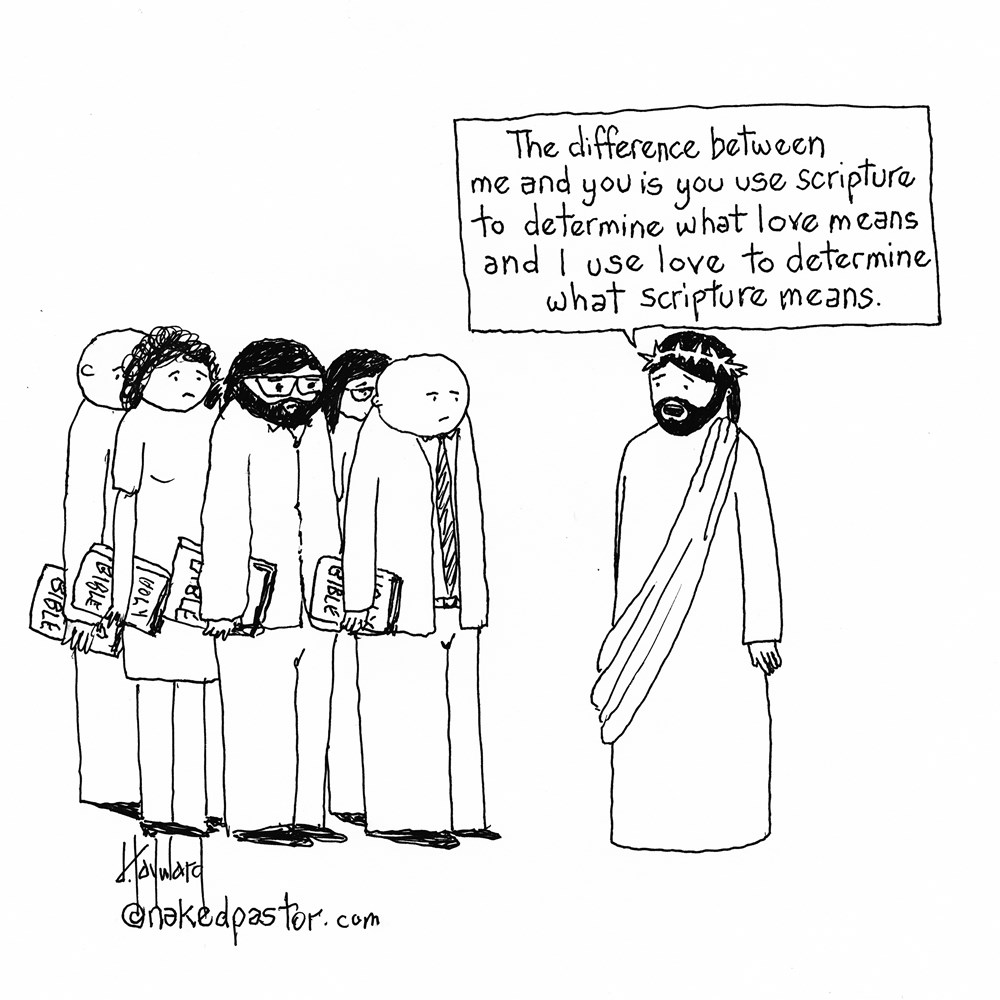
The cartoon above appeared in the Church Times on 7th November 2025
How we use scripture is crucial to our mission and to our personal growth in faith. It is one of the ways that God shapes us as Christians.
For Christians scripture, the Bible, has authority. In the Church of England it is believed that scripture has authority for the establishment of doctrine (The Thirty Nine Articles of Religion, Article 6, Of the Sufficiency of the Scriptures). Nothing can be established as essential to be believed unless it can be justified by scripture. The faith as outlined in the Creeds fall into that category – they don’t require us to affirm anything that cannot be justified by scripture.
That all seems very simple – we believe what scripture teaches us. Reading the Bible should tell us everything we need to know.. When we read the Bible it will clearly reveal the God-given truth to us. But, of course, it is never that simple.
The moment we open the Bible to read it, in the privacy of our home or in the worship of the Church, we interpret what we read. We bring our own context to it.
When preaching I often (almost always) say when trying to understand a biblical text that context is key. But I do not refer only to the context in which Jesus said the things he said, or did the things he did, but also in the context in which we read the text.
It is almost always a mistake to read a verse from the bible in isolation. Think of John 13.14,
If I, then, the Lord and Master, have washed your feet, you must wash each other’s feet.
If we read that single verse and tried to apply it in our own lives even our Christian friends would think us a little odd. Out of context it is an instruction to literally wash each others feet; but in the context it is about becoming the servants of each other and about treating each other with humility and generosity.
If I were to read that single verse with the wish to find out what Jesus wants me to do (my context for reading) then I shall want to be washing feet. But if I read it wanting to find out how Jesus wants me to respond to my Christian companions it will tell me so much more.
This, broadly speaking, is the message that this cartoons gives. In the one case we would be using scripture to find out what love means. In the other we would be using love to determine what scripture means.
This is just a single example but the point, I think is well made. The bible doesn’t so much tell us what love means, but love tells us what scripture means. Scripture reveals so much more when we come to it not looking for answers but for guidance; not so much looking for instruction as for clues as to how to work out our discipleship for ourselves.


Leave a Reply