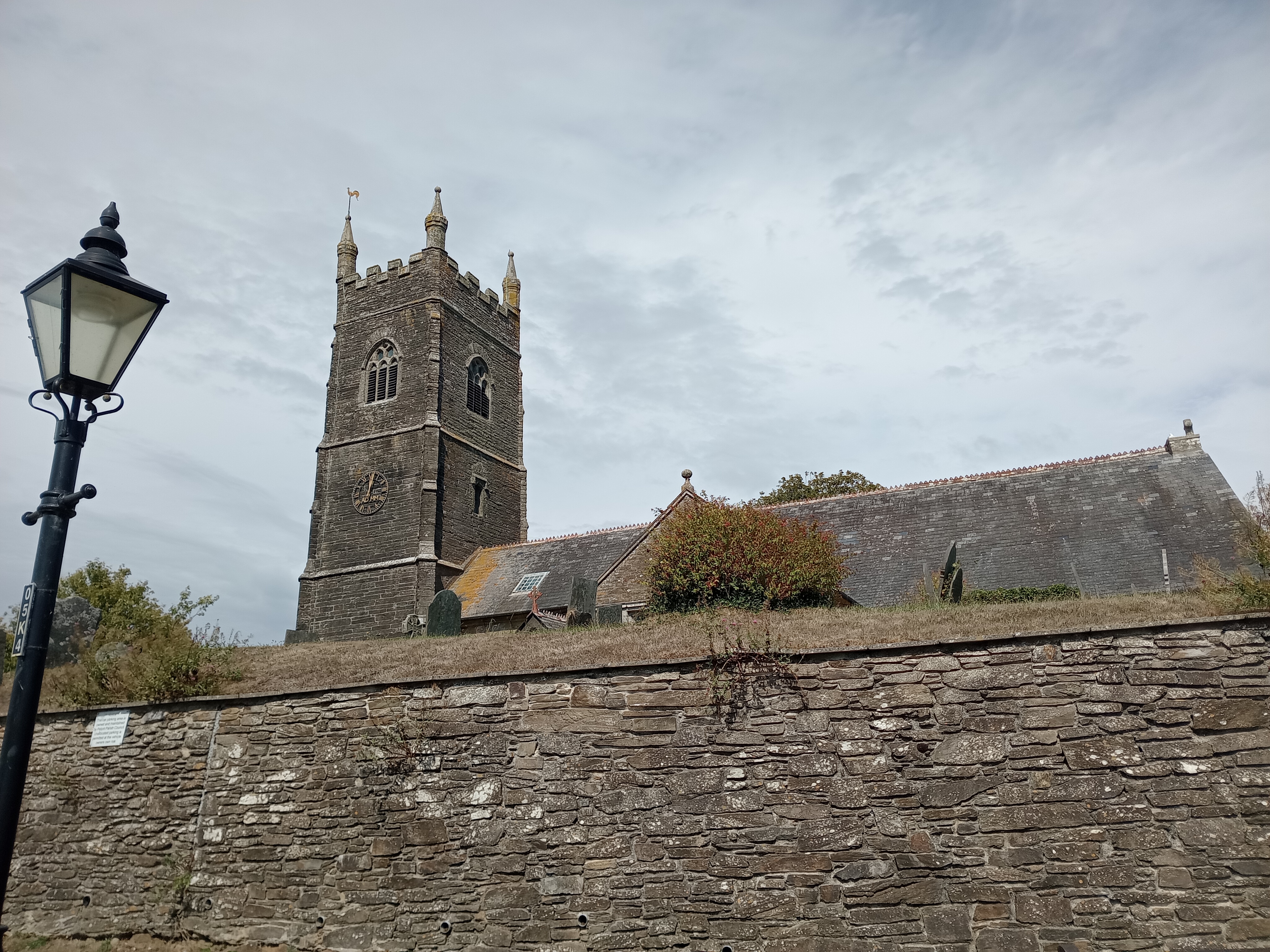
The text of a sermon preached at the Church of St Nun, Pelyn, Cornwall on Sunday 30th August 2026
The readings were, Exodus 31-15 Romans 129-end Matthew 169-end
Jesus began to show his disciples that he must go to Jerusalem and suffer grievously at the hands of the elders and chief priests and scribes and to be put to death and to be raised up on the third day.
On 30th July sixty years ago I was on a scout camp in, if I remember correctly, the New Forest. That day was the date of the World Cup Final which England would go on to win. We had all resigned ourselves to not being able to see it. However, the farmer on whose land we were camping offered to have six of us join him and his family to watch on his television. So, a half dozen of us were chosen and I was one of the lucky ones. There was much excitement as you can imagine. Then …
Then our new assistant scout master stepped forward and said that we were all needed to build a bridge across a stream – the sort of thing that scouts did then when they were camping with ropes and pioneering poles in the 1960s – and so we would not be able to go and watch the match. I never saw England’s only triumph in a World Cup Final.
Imagine our disappointment – especially when we discovered that the stream we were to bridge was about three inches deep and could be easily stepped across.
The bridge was an impressive structure but pride in its construction could not compensate for the disappointment of missing the excitement of England winning the trophy.
I’m over it now but disappointment can cut very deep.
In today’s gospel we come to a key moment in the ministry of Jesus. In the previous few verses Jesus had asked his disciples,
But you, who do you say I am?
It was Simon Peter who answered,
You are the Messiah, the Son of the living God.
Jesus doesn’t deny this but praises Simon, and renames him, Peter, the rock, for his openness to what God is saying to the disciples,
Blessed are you, Simon son of Jonah, for flesh and blood has not revealed this to you but my Father in heaven.
Over their time with Jesus the Twelve must surely have talked among themselves about who Jesus was, and what his mission was all about and wondered whether he might be the eagerly anticipated Messiah. It’s only Peter that dares to suggest this to Jesus – but surely it is what they all are thinking.
But now Jesus is dashing their hopes by saying that he will be put to death by the Jewish authorities – not what they would have been expecting from the Messiah.
How disappointed they must have been in that moment. If Jesus is the Messiah he is certainly not the sort of Messiah they were expecting. How can he lead the rebellion against the Roman occupation if he is going to die? How can he be the Messiah if it is the Jewish leaders who will have him done away with?
And as before it is Peter who speaks up,
Heaven preserve you, Lord, this must not happen to you.
Peter simply cannot imagine that Jesus is serious about being put to death rather than leading some sort of uprising.
The disappointment of Peter and the other disciples is palpable. Their whole world is being turned upside down.
This is the first time in the gospel that Jesus predicts his coming death and resurrection. It marks a moment of new beginning for him. The focus of his ministry from here is not so much on the proclamation of the good news or the healing of the sick, but on setting himself towards Jerusalem and preparing for his death – although it will be a death that he knows, what the disciples do not, which will change the world for ever, as it will lead to his triumph over death through the resurrection.
This changes everything, too, for the disciples. They can no longer see themselves as part of a popular movement which will result in the liberation of Israel and the setting up of Jesus as some sort of earthly king.
Jesus is going to Jerusalem to die – they almost certainly won’t have taken in the and raised up on the third day. And we know – because we know what follows – that the Twelve are being prepared now by Jesus for what they must do after the resurrection. It is only when the empty tomb is discovered that they will remember what he has said today about being raised up on the third day.
And then they will be able to begin to make sense of all that is happening as Jesus sets his face towards Jerusalem and his death and resurrection.
At this point in the gospel the disciples feel a deep sense of disappointment – perhaps they’re even feeling that Jesus has tricked them into following him on false pretences. Maybe they feel that they have been let down.
But the response, in this moment, of Jesus to Peter must have shocked them – and perhaps, when they reflected on it, reassured them that Jesus was serious, and that his death was necessary.
Get behind me, Satan! You are a stumbling-block to me, because you are thinking not as God thinks but as humans do.
Today we tend to think of Satan as a sort of name of the devil. In the original Hebrew it is not so much a name as a description. The Satan was the adversary, the opponent, the tempter. It has that meaning here in this context. Peter is being told not to get in the way of what Jesus must do, not to be an obstruction or a blockage. It’s certainly a forceful word but does not quite have the meaning that we usually associate with it.
For Jesus to address Peter, who only a little while ago was called Blessed by Jesus, will certainly have made the disciples stop and think.
The upshot of this exchange makes the disciples realise that such has been their experience of their time spent with Jesus that not one of them walks away from him. They all stay and stick it out to the end. They work through the disappointment, and, although they abandon him at the end, they come back and, filled with the Holy Spirit, spread the good news throughout the whole world.
The disciples will need to rethink what they believe about Jesus and in that process they will come to realise that up until this point their idea of who Jesus is and what his mission is has been TOO SMALL.
He is not a revolutionary leader in a small, but troublesome, Roman province but, as Peter had said, the Messiah, the Son of the living God, and is bringing hope not just to the people of Israel but to the world.
Jesus does bring a revolution but it is one that will turn the whole world upside down.
But, of course, the question which we have to ask ourselves is, are our perceptions of Jesus too small and our understanding of what we are called to be and to do too limited? Are we doing what Peter was doing when he responded, Heaven preserve you, Lord, this must not happen to you? Are we being an obstruction, a blockage, an adversary to Jesus.
It may be, indeed I think it probably is, the case that our vision of what we are called to be as disciples of Christ is not wide enough. It’s too limited.
I’m sure that we, as Christians here in Pelynt, ponder often how we can grow the churches here; how can we thrive as St Nun’s or as Pelynt Methodist Church? How do we get young people in? How do we reach out to our community?
They’re not unimportant or insignificant aims but surely the real question is, How do we proclaim Jesus Christ as Messiah and Son of the living God?
Because that is the big truth that has been revealed to us, and that is the truth we must share.
That is what the disciples were called to do after the death and resurrection of Jesus – and it is still what we are called to do today? It’s about seeing the big picture, having a big vision.
It’s not about making our little churches thrive, but about proclaiming Jesus as Messiah and Son of the living God to the world.

