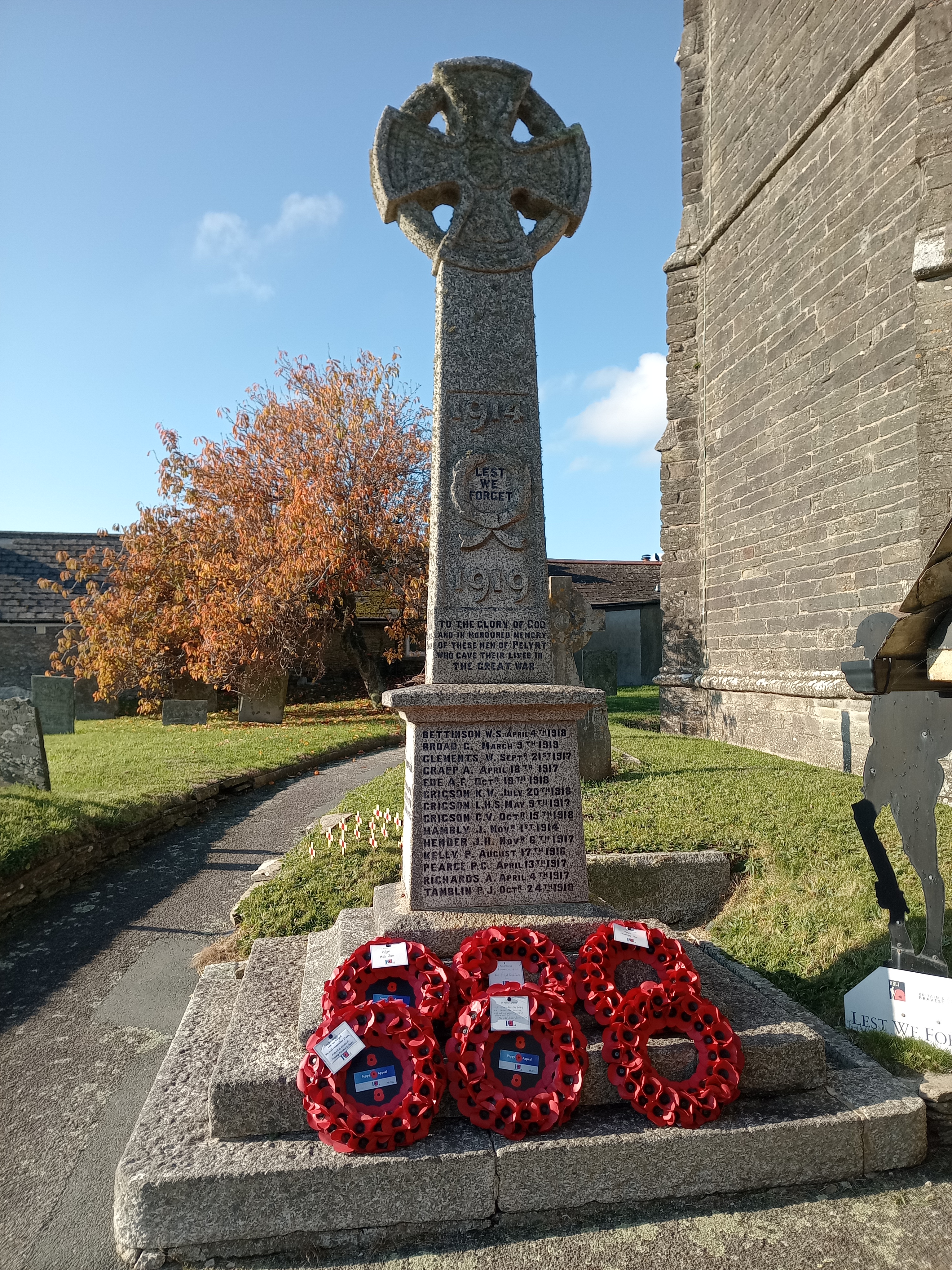
The text of a sermon preached at St Nun’s Church, Pelynt, Cornwall on Remembrance Sunday, 8th November 2026.
The reading was, Romans 831-39
Every year we gather in our villages, towns and cities to remember the fallen of two World Wars and other conflicts. Some of those gatherings, like that at the Cenotaph in London, will be enormous, others in villages up and down the country will, like ours, be lower key but nonetheless significant and important.
We will remember the fallen, we will take pride in their courage, we will lay our wreaths, we will wear our poppies, we will observe our silence and we will pledge ourselves afresh to work for peace and reconciliation, as we have as a nation, and as communities, for more than a century.
For some of us this act of remembrance is filled with sorrow and grief for those in our own families who paid the price of war. As the years pass fewer of us each year mourn those who were known to us personally but that does not diminish the importance of what we gather to do – indeed it may make it more vital than ever.
This is no meaningless ritual. As we read out the names of those who died in two World Wars from our villages we are reminded of the cost of war to families; perhaps there are family names in our lists we still recognise among us today, perhaps names of families who have moved away and who no longer live here, but nevertheless families just like ours. Fathers, sons, brothers, husbands who went off to war believing that this was the right, the just thing to do, but who never returned leaving behind only memories of happier times, and grieving loved ones.
Their sacrifice may be remote to most of us now but today reminds us that their lives still mean something; their sacrifice is still important to us.
The remoteness in time from the two World Wars of the last century might make us complacent – and this why what we are doing today is so important. It is why it is crucial that we do not allow remembrance to become meaningless or irrelevant to our life today.
At the War Memorial this morning, when we laid our wreaths and kept silence, we heard the words of the Kohima Epitaph,
When you go home, tell them of us and say,
For your tomorrow we gave our today.
And towards the end of this service we will be asked these questions as part of our Act of Commitment,
Will you strive for all that makes for peace?
Will you work for a just future for all humanity?
Because Remembrance is not just about the past. It is also about the future we wish to create – for ourselves, for our children and our grandchildren.
Although we remember principally those who died in the two world wars we should not forget that members of our armed forces have died in many other conflicts since. In Malaya, in Korea, in Bosnia, in Northern Ireland, the Falklands, in Afghanistan, and elsewhere.
And, while it may be the case that, as a nation, we are not actively involved in a current conflict, we know that throughout the world war and conflict continues as it always has.
War anywhere affects the whole world, and affects us. It heightens tensions, it creates refugee crises, it affects economies, it destabilises areas of the globe, it threatens the safety of neighbours.
Today, there are nineteen current wars in the world. Some we’re familiar with – Ukraine-Russia, Iran-USA/Israel, Sudan and Myanmar. Others are less well known, but no less important, and alarming, for those affected.
It’s easy to imagine that wars far away are nothing to do with us, but we only need to look at the war in Ukraine to realise that within its range of possible outcomes is a Europe-wide, or worse, conflict. And our security forces are already making clear that Russia poses a real threat to our security, not just in the future, but today. And what is true there can be true elsewhere.
And these wars, in Eastern Europe and the Middle East, are warnings to us too that war is not what it was. War, like everything else, has evolved in our internet-age. Drones pose the possibility of more targetted attacks on infrastructure and people than in the past. Greater accuracy though does not mean less damage to civilian life. Indeed, as we are seeing in Ukraine or in Iran or Gaza, the very opposite might be true. War can now be conducted from thousands of miles away, by combatants, operating weapons that can inflict great damage to infrastructure and people alike, sat at a computer screen and using a device like a games controller.
Thus, the challenge of Kohima, and the Act of Commitment, become much more urgent. We forget the sacrifice of those names on our War Memorials at our peril. When we forget the ties we have of common humanity with people throughout the whole world we cannot but place a lesser value on human life. If we forget the human cost of our history, and if we ignore the human cost of wars in Ukraine, or Iran, or Gaza, or Israel, or Sudan, we devalue all human life – including our own and that of our close neighbours.
And so, this morning, as we recall the commitment to peace and justice of those who fought and died in past wars, we need to approach our Act of Commitment with a seriousness which puts a real value on every human life. We need to recognise that each of those lives has a real worth – certainly in God’s eyes. And it should be in our eyes too. We need to remember that every person in the world is a person made in the image of God. And that, in the words of St Paul, which we heard read this morning,
For I am convinced that neither death nor life, nor angels, nor rulers, nothing already in existence and nothing still to come, nor any power, nor height nor depths, nor any other created thing will be able to separate us from the love of God in Christ Jesus our Lord.
Nothing can ever separate any one of us from God’s love – whoever we are, whatever we do, wherever we live. We are one human race. War divides us and sets us against each other. This is why Remembrance is so important. And why it is a duty laid upon us to work together, for peace, justice, reconciliation and unity. To do otherwise is to fail to honour the sacrifices of those who died in war for us.


