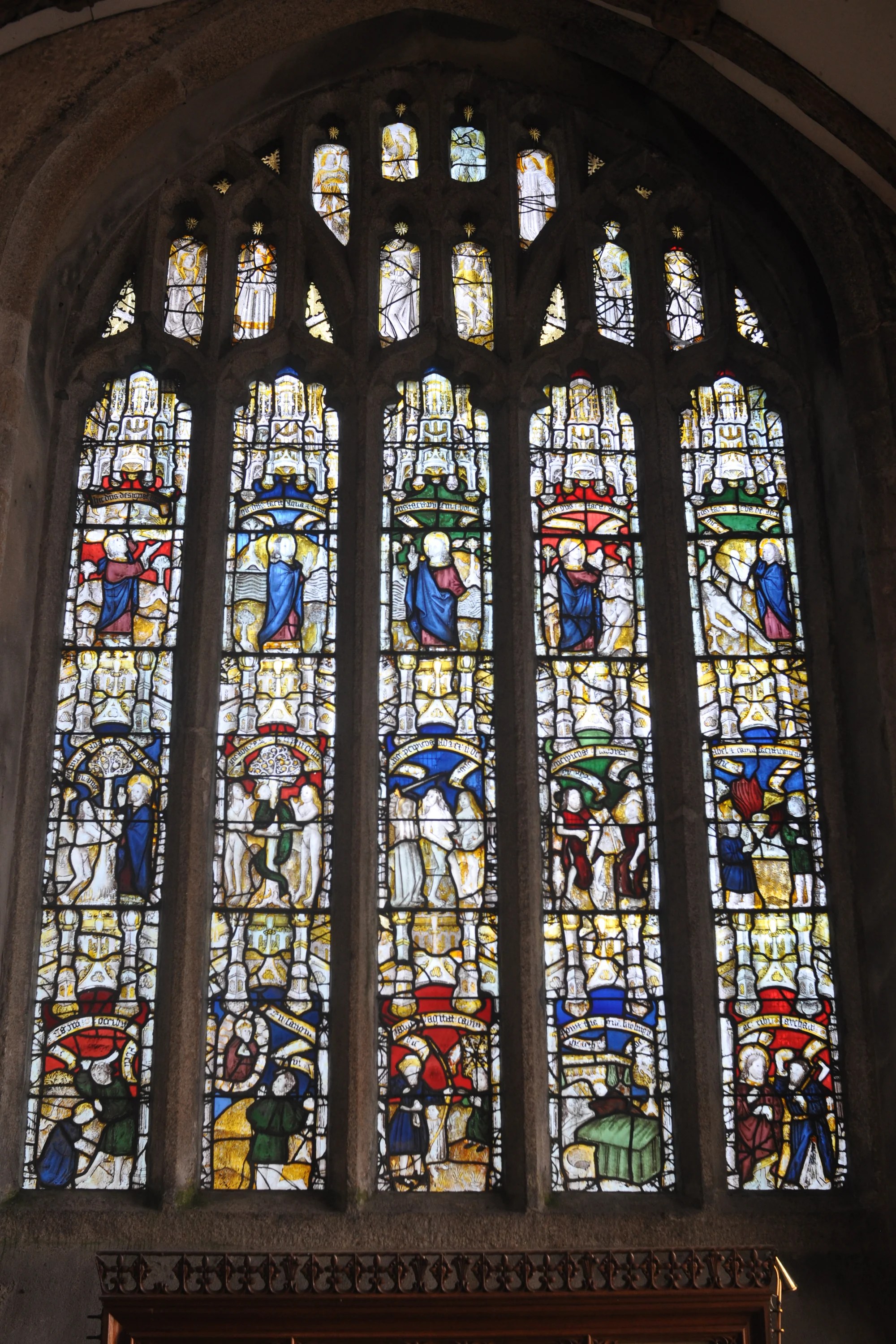
The text of a sermon preached on Sunday 13th September 2026 at the Church of St Melor, Linkinhorne, Cornwall.
The set readings were, Exodus 1419-31 Romans 141-12 Matthew 1821-35
Peter went up to him and said, “Lord, how often must I forgive my brother or sister who wrongs me? As often as seven times?”
Then the master sent for the man and said to him, “You wicked servant, I cancelled all that debt of yours when you appealed to me. Were you not bound, then, to have pity on your fellow-servant just as I had pity on you?”
Forgive us our trespasses, as we forgive those who trespass against us.
Forgiving people is the easiest thing in the world – until it isn’t!
A little over forty years ago I was just beginning my second curacy in Southmead in Bristol. We didn’t have a huge congregation – just 20 or 30 people on a good Sunday – but there was no shortage of the faithful and devout people who make up the core of all of our congregations.
There was one man, Geoffrey, in particular that I recall. Not long after I had started in the parish I visited him in his home. His wife made us tea and brought some cakes and we got to chatting. He was in his late sixties, I guess, and he was the sort of person we tend to speak of as a pillar of the church, a committed Christian and someone who lived out an obvious and attractive faith. He had held offices in the church as churchwarden and represented us on the deanery synod. He prayed and read his bible. He had a clear idea of how a Christian should live their life.
But there was one part of his life of which he was deeply ashamed – there was one group of people that he could not forgive. He told me,
I try; I know I should; I pray to God about it. But even now, after all these years, I cannot forgive. If one of them walked in the room now I would get up and leave for fear of what I might do or say.
Like most other men of his generation he had served in World War II and he was one of those who had been a prisoner of the Japanese in the Far East. He could not forgive – not so much for the things that had been done to him, as for what he saw done to his comrades. He knew that his Christian faith demanded that he forgive, but he simply could not manage it.
“Lord, how often must I forgive my brother or sister who wrongs me? As often as seven times?” Jesus answered, “Not seven, I tell you, but seventy-seven times.”
‘”You wicked servant, I cancelled all that debt of yours when you appealed to me. Were you not bound, then, to have pity on your fellow-servant just as I had pity on you?” And in his anger the master handed him over to the torturers till he should pay all his debt. And that is how my heavenly Father will deal with you unless you each forgive your brother and sister from your heart.’
Forgive us our trespasses, as we forgive those who trespass against us.
Forgiveness is not an optional extra – but that doesn’t mean that it is ever easy. We are required to forgive. But we all know that, like Geoffrey, there are things that we would find difficult, or even impossible, to forgive.
Jesus had just said to his disciples, whatever you bind on earth will be bound in heaven; whatever you loose on earth will be loosed in heaven. Withholding forgiveness is serious.
And here Peter’s question suggests that he thinks that there are, or should be, limits to how much he can be expected to forgive a brother or sister who wrongs him.
How much? How often? Really? That much? There must be a limit – there must be a sin that cannot be forgiven, or a sin too many.
But seventy-seven is not to be taken literally. I’m sure it means quite a few more times after you’ve lost count.
But it is not just about how often we should forgive someone but, as the parable of the unforgiving debtor teaches us, being forgiven ourselves is tied to how ready we are to forgive,
that is how my heavenly Father will deal with you unless you each forgive your brother and sister from your heart
And, as we pray whenever we worship together or in our own home, in the Lord’s Prayer,
Forgive us our trespasses, as we forgive those who trespass against us.
But perhaps that parable has something else to teach us about forgiveness that is easily missed because we always think about the contrast between the two debts – the one enormous and the other trivial – and never about why the first servant, forgiven so much, is unable to respond with mercy to his fellow servant.
The debt is absurdly large – Jesus frequently uses hyperbole, exaggeration, to emphasise a point. And surely that is what he is doing now.
Ten thousand talents doesn’t really mean a great deal to us. We know that it’s a huge sum because preachers and commentators have told us so,The disciples hearing this parable for the first time knew well how large a sum it was and they would have been shocked that anybody could have borrowed – or loaned – so large a sum. Then, hearing the rest of the parable they and we, hearing it today, are shocked that somebody could be forgiven so much and their life changed so little. And I think that is the point.
Being forgiven should change us. It should lead us to review our life. It should make us different people.
How can he not be changed? We don’t know, and we cannot begin to imagine, but clearly the first servant is not changed. And if he is not changed it must surely be because he does not feel forgiven.
We can only guess why that might be so. However, we probably do not need to do so. The parable shows us that being forgiven in a way that changes us means that we in turn can be forgiving; if we are not changed we will not be forgiving.
Forgiveness is at the very heart of what makes us Christians Being forgiving is one of the ways in which we become more like Christ – because forgiveness was one of the hallmarks of his ministry, and even as he went to his death on the cross, Father, forgive them. They do not know what they are doing.
Forty years ago I had no idea what to say to Geoffrey – I still wouldn’t. But I do know that sometimes it is very hard to forgive. But I also know that he was closer to doing it than he realised. He wanted to forgive, but it was always a step too far for him; the thing he needed to forgive was too big – but not for God. And sometimes we can only pass it on to God, because he sees into our hearts and heals us by his grace. It is all that remains.
When we cannot forgive all we can do is hand it on to God in prayer. Pray that God will forgive what we cannot – because we know that we should forgive but it is not always easy,
that is how my heavenly Father will deal with you unless you each forgive your brother and sister from your heart.
Forgive us our trespasses, as we forgive those who trespass against us
As we ask God to forgive those, that we cannot forgive, who have wronged us we should ask him too to forgive us and give us grace to find forgiveness in our heart.