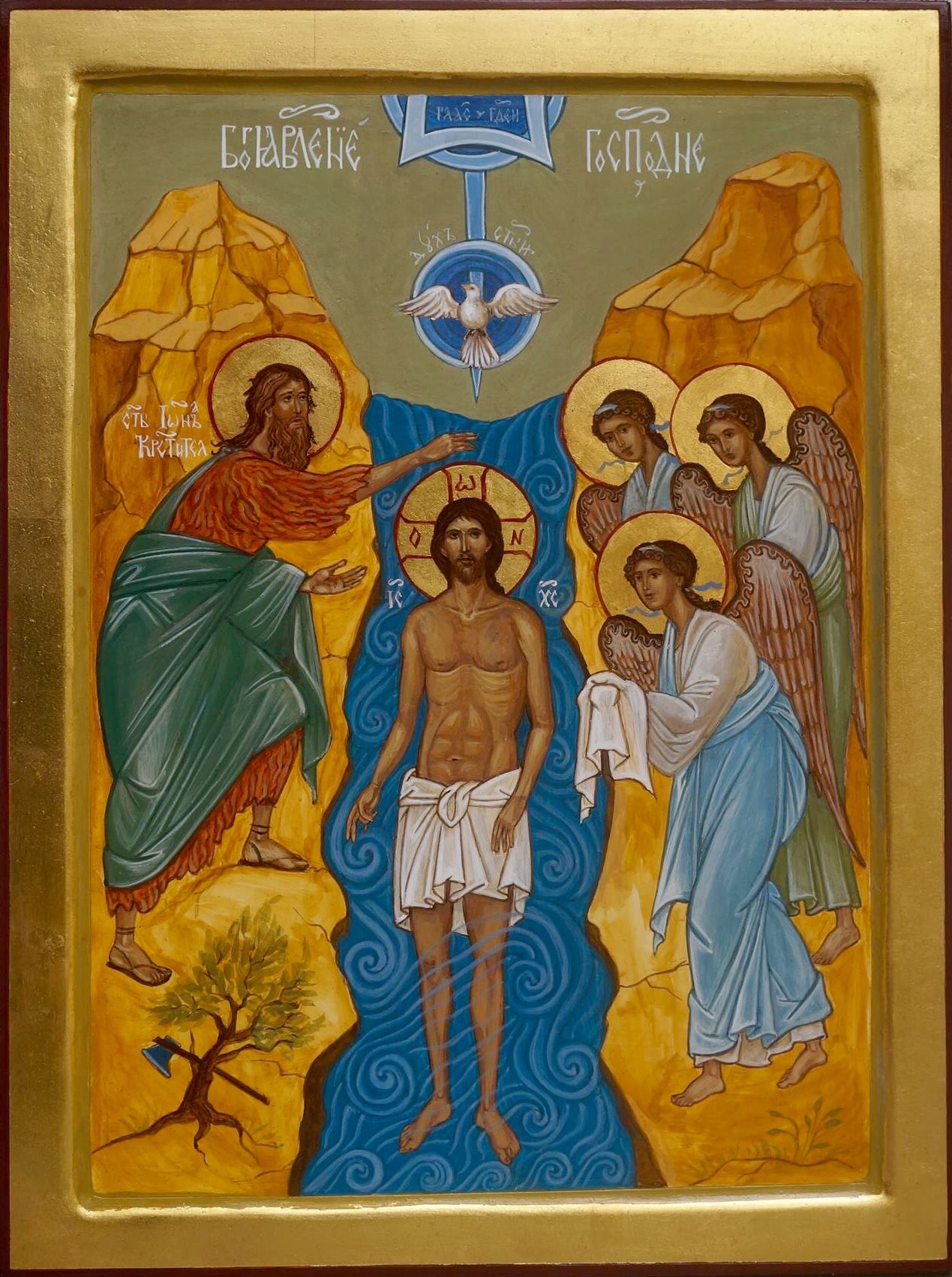
This is the text of a sermon preached for the Baptism of Christ, Sunday 11th January 2026, at the Church of St Melor, Linkinhorne, Cornwall
Isaiah 421-9 Acts 1034-43 Matthew 313-end
Then Jesus appeared: he came from Galilee to the Jordan to be baptised by John.
Up to this point in Matthew’s gospel all that has been recorded is the genealogy of Jesus – tracing his ancestry back to David and then to Abraham, a story of his birth, the account of the coming of the magi and the gifts they bring – gold, and frankincense and myrrh, the flight of the Holy Family to Egypt and their return to Nazareth, and an account of the proclamation of John the Baptist.
And now with these words Matthew begins his record of the adult ministry of Jesus,
Then Jesus appeared: he came from Galilee to the Jordan to be baptised by John.
This is Matthew’s way of telling us that it is what follows that we need to pay close attention to. All that has come before is important because it tells us who Jesus is, establishes his credentials if you like – a descendant of David and Abraham, affirms his status as an Israelite and as the anticipated Messiah; conceived by the Holy Spirit; that he is Immanuel, the God who is among us; recognised by the Gentiles in the persons of the magi; and witnessed to by John as the one who inaugurates the kingdom of Heaven.
Jesus’ appearance at the Jordan where John is baptising marks the beginning of his adult ministry. It’s a watch this space moment.
And the moment does not disappoint.
John objects that it should not be him baptising Jesus so much as Jesus baptising him. But Jesus insists that by doing this they should do all that uprightness demands, with the humility that is a hallmark of much of Jesus’ ministry.
Now is not the time to rock the boat. John has an important ministry, preparing the way for Jesus. Jesus is not ready to deflect attention away from John and onto himself. The time for that is not far away, but it’s not now.
So far in his life Jesus has been an unknown. This is the moment when he takes the stage. He may have no need to repent but his acceptance of John’s baptism is a symbol of his fresh beginning, of his turning away from his home and family life and following the path set out for him by God.
When we speak about repentance it’s not just about being sorry for sins. It is also, crucially, about our turning around and taking a new direction in our life.
Jesus may not have had sins to repent of but this is a moment in his life when he turns around and takes a new direction, putting the past behind him.
And we see other moments in the gospels, all of them significant, where Jesus turns and sets himself in a new direction.
Moments such as, when Jesus visits Jerusalem with Mary and Joseph, in Luke’s gospel (Lk 241-50) with his parents and is chided for causing them anxiety and he responds,
Did you not know that I must be in my Father’s house?
The moment in the wilderness when he rejects Satan’s enticements to sin (Mt 41-11)
Then Jesus replied, ‘Away with you, Satan! For scripture says: The Lord your God is the one to whom you must do homage, him alone you must serve.’
And the moment when he sets his face towards Jerusalem, in Matthew’s gospel (Mt 1621-23),
From then onwards Jesus began to make it clear to his disciples that he was destined to go to Jerusalem and suffer grievously at the hands of the elders and chief priests and scribes and to be put to death and to be raised up on the third day.
And there are other moments – in the Garden of Gethsemane, before the chief priests and Pilate when he is put on trial – where Jesus consciously makes the choice to obey God’s will.
And, like his response to John at his baptism, these are all moments of repentance in the sense of turning in the right direction.
And so John relents and baptises Jesus.
And when Jesus, having been baptised by John, came up out of the water,
suddenly the heavens opened and he saw the Spirit of God descending like a dove and coming down on him. And suddenly there was a voice from heaven, ‘This is my Son, the Beloved; my favour rests on him.’
It is as if these five verses affirm all that has been claimed for Jesus in the preceding two and half chapters and set the context in which the whole of the rest of the gospel should be read.
And more than that. The events around Jesus’ baptism are one of the keys, together with the events at the end of the gospel – the passion, death and resurrection – to our understanding of who Jesus is and the significance of all that he does.
We cannot read the gospels without the knowledge that Jesus is proclaimed, at his baptism, to be God’s Son, empowered by the Holy Spirit; just as we cannot read them without the knowledge that, three years later, Jesus will be put to death on the cross and will rise again after three days.
These are the events that define Jesus and our understanding of him.
So what does it mean to us that the Holy Spirit comes down on Jesus and that he is acclaimed with these words,
This is my Son, the Beloved; my favour rests on him?
These events reveal, right at the beginning that Jesus’ life and ministry are God-given and God-empowered.
This truth may seem obvious to us now but it is important that this truth is revealed at the outset of his activity and not simply revealed to us by his death and resurrection.
Jesus’ actions – his miracles, his healing of the sick and the disabled, his teaching, are as important for us to reflect on as the significance of the self-sacrificial act at the end of his life.
God is revealed in every part of his ministry – not just in his dying and rising again. The whole of his story is important for us.
At his baptism Jesus turns his life towards God. And this is something he does again and again throughout his life.
This story reminds us that turning towards God is something we need to do again and again. And as we do our faith is renewed, and, like Jesus, we are blessed by the presence and infilling of the Holy Spirit to fulfil our calling in Christ.
 exultemus