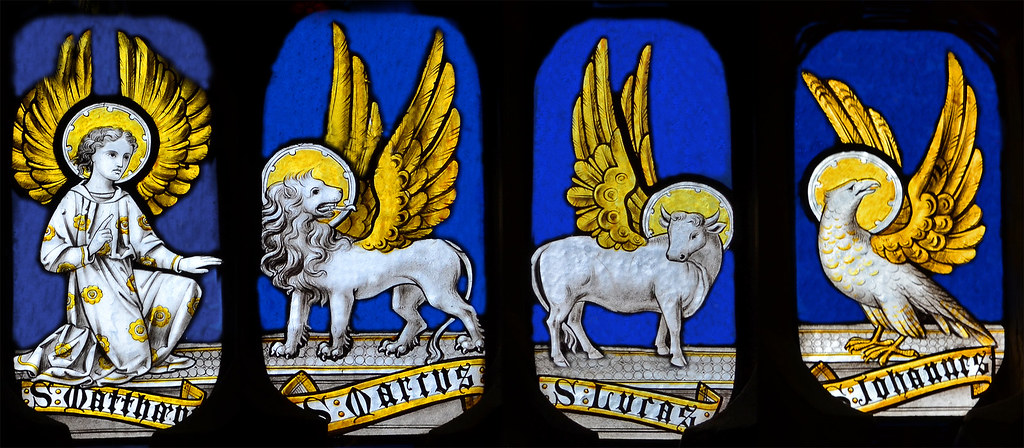
The New Testament opens with the four gospels – Matthew, Mark, Luke and John. The word gospel means Good News from old English. It is a translation of the Greek euangelion.
The gospels on the face of it simply tell the story of Jesus’ life. However, it is not the case that they are biographies in the modern sense. Rather, they are concerned to reveal why Jesus is so important to Christians by each writing down an account of Jesus’ ministry and teaching. The accounts do not share the same chronology and the events they record are chosen, it would seem, to reveal who Jesus is more than what Jesus did.
In spite of many similarities and overlapping points the four gospels unambiguously share only three events of Jesus’ life in common – his baptism by John, his passion and his resurrection – and even these they record differently.
The authors’ names are derived from long standing traditions. Matthew and John are said to be members of the twelve disciples Jesus gathered around him as his closest associates. Mark is said to have been a companion of Peter and is mentioned in the Acts of the Apostles and in Paul’s letters. Luke is believed to be the beloved physician mentioned by Paul and one of his companions on his journeys.
The gospels are almost certainly the result of the shared memories and stories of Jesus of the Christian communities from which each of them originated. It is quite possible that the communities in which they were formed were associated with, or perhaps gathered around, the disciples for whom they are named but we can have no certainty.
All we can say with absolute certainty is that these four gospels bear witness to the historical Jesus and reveal his significance for our salvation. They have shaped our faith and the history of the world for more than two millennia.
They have been, and continue to be, essential reading for every Christian.
 exultemus